Al Schneider's Rocky Mountains Plant Descriptions

Oxeye Daisy
Leucanthemum vulgare
Aster family (Asteraceae)

Oxeye Daisy was intentionally introduced from Europe as a garden plant; it was especially popular in mining towns and that is why we see it spreading in the high mountains. It is considered an invasive species in many states. The plant has been used in a wide range of medical applications including the treatment of whooping cough. Flowers are long-lived, large, and attractive, so much so that they are often in so-called "wildflower" seed packs -- thus spreading this invader even more. Look for this plant in disturbed areas -- and pull them out. Linnaeus named the Chrysanthemum and he named this species in 1753. The species was moved to the Leucanthemum in 1779 by Jean Baptiste de Lamarck. "Leucanthemum" is Greek for "white flower" and "vulgare" is Latin for "common."
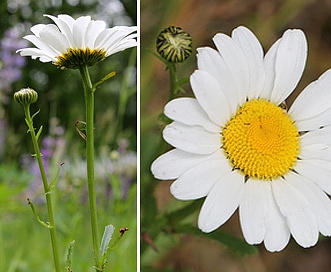

©2014 Steve Sullivan, Yan Soucie
Description

Introduced , 10-24" tall, with unbranched stems. Showy white flowers, 1-2" wide, are solitary at end of long leafless stems. Flowerhead consists of 15-35 around a yellow . are narrow, brown and papery. are , spoon-shaped, with or margins. are while stem leaves are smaller without stalks.

Field Marks

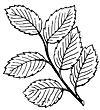
Showy white flowerheads, spoon-shaped coarsely , and unpleasant odor.

© Al Schneider

A perennial plant lives and blooms for many years.

A herb is a plant whose stems die back to the ground in the winter.

ray flowers -- The outer petals of a sunflower or daisy are ray flowers.

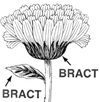
Bracts are modified leaves associated with a flower.

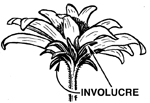
Involucre is the name given to the circle or spiral collection of bracts around a flower-cluster.

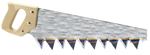
Like the teeth on a saw, leaves and other surfaces can have toothed edges.

stalk -- The supporting structure of an organ. Examples of stalks are stem, peduncle, petiole, ...

disc flowers are those in the center of a sunflower or daisy. Not a ray flower.

included -- Enclosed and not protruding. For example, stamens within the corolla.

genus -- A subdivision of a botanical Family in which all members have a significant number of similar characteristics.

alternate -- leaves alternate along the main stem and are attached singly.

basal leaves -- a leaf that grows lowest on the stem of a plant.

lobe -- Being divided by clefts.