Al Schneider's Rocky Mountains Plant Descriptions

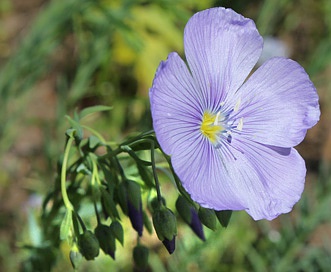
Lewis Flax
Linum lewisii
Flax family (Linaceae)

When roasted, flax seeds have a pleasant nutty taste and are very nutritious. Do not eat raw seeds for they contain cyanide which is destroyed in the cooking process. Numerous medicinal uses are reported for Blue Flax and its oil is similar to that of linseed. Blue Flax might be confused with Chicory but Blue Flax fills and at foothills elevations Chicory (Cichorium intybus) fills fields with a very different shade of blue. Chicory is an introduced plant with 5- edges and similar-color and . Meriwether Lewis collected the first specimen of Blue Flax for science in 1806 in the Rockies.

©2014 Steve Sullivan
Description

Slender branched , 1-2' tall, often rising above surrounding grasses. Closely spaced leaves are , , and 1-. Varying shades of blue flowers have 5 broad petals, 5 , and 5 that are longer than the .

Field Marks

Bright blue, 5-petaled flowers on slender stems.

© Al Schneider

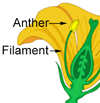
stamen -- the pollen-producing reproductive organ of a flower; The stamen consists of an anther supported by a filament.

nerves -- Another name for a vein.

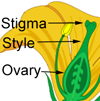
style -- This is a long and thread-like structure that connects the stigma with the ovary. A flower may have a single style, or several of them.

A perennial plant lives and blooms for many years.

A herb is a plant whose stems die back to the ground in the winter.

linear -- Long and very narrow like a blade of grass.

Like the teeth on a saw, leaves and other surfaces can have toothed edges.

The anther is a pad at the end of the stamen that holds the pollen.

montane -- inhabiting mountainous country but below timberline.

alternate -- leaves alternate along the main stem and are attached singly.

meadow -- Large grass and wildflower filled area with few, if any, trees.