Al Schneider's Rocky Mountains Plant Descriptions

Twinberry Honeysuckle
Lonicera involucrata
Honeysuckle family (Caprifoliaceae)

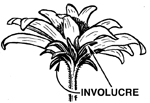
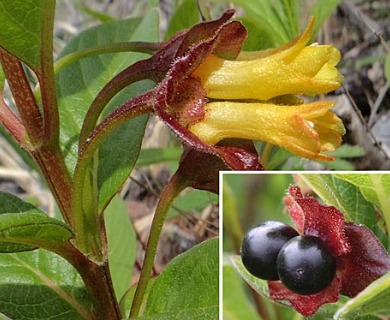
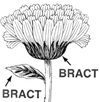
Twin Flower and its are distinctive, as are those of a number of other Honeysuckle Family members. The of Twinberry is reputed by some to be edible and have a number of medicinal uses but by others it is said to be toxic. The is used as a dye, as you might learn first hand when you handle the ripe . "Lonicera" honors German physician and herbalist, Adam Lonicer (1528-1586). "Involucrata" is Latin for "wrapper," thus the common botanical term "," the whorl of below a flower.

©2014 Steve Sullivan
Description

Erect to spreading shrub, 2-7' tall, with opposite, short-, elliptical, sharp-pointed leaves. Young twigs green 4-angled. Yellow flowers in pairs in leaf axils, backed by conspicuous broad purple . a black, spherical 3-celled .

Field Marks

Shrub with twin hanging yellow flowers and dark blue/black that are both subtended by large showy .

© Al Schneider

Bracts are modified leaves associated with a flower.

Involucre is the name given to the circle or spiral collection of bracts around a flower-cluster.

Deciduous plants are those that lose all of their leaves for part of the year.

fruit -- any seed-bearing structure in flowering plants. It is formed from the ovary after flowering.

stalk -- The supporting structure of an organ. Examples of stalks are stem, peduncle, petiole, ...

The botanical term "berry" is different from common usage. Strawberries and raspberries are not berries. But a tomatoe is. A true berry is a fruit with the seeds immersed in the pulp.