Al Schneider's Rocky Mountains Plant Descriptions

Diamond-leaved Saxifrage
Micranthes rhomboidea
Saxifrage family (Saxifragaceae)

Snowball Saxifrage (Micranthes rhomboidea) has tiny snowball flowers in a spherical cluster on a slender . The plant is commonly and easily seen scattered, sometimes abundantly, in . At lower elevations this Saxifrage is easily lost in other foliage. Snowball Saxifrage might be mistaken for American Bistort (Bistorta bistortoides). Snowball Saxifrage's similar looking close cousin, (Micranthes oregana) is much less common in Colorado. It is more elongated, multi-flowered, with thicker more elongated leaves. In 1889 Edward Lee Greene collected the first specimen of Micranthes rhomboidea for science in Arizona. He named it Saxifraga rhomboidea in 1898. John Small (1869-1938) renamed it Micranthes rhomboidea in 1905.
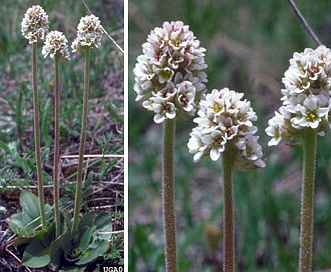

© Dave Powell, USDA Forest Service, Bugwood.org

Description

plants. Leaves with from 1 to 2 1/2" long, including the short , in a , sometimes , , margins. 4-12" tall, . (head-shaped). abut 1/8" long, erect. Petals about 1/5" long, white. a .

Field Marks

of thick diamond shaped leaves topped by leafless flower stem with spherical cluster of tiny white flowers.

© Al Schneider

ciliate -- fringed with hairs

An entire leaf has smooth edges. Not toothed or lobed.

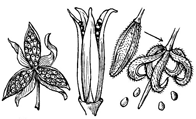
capsule -- a type of simple, dry fruit produced by many species of flowering plants. In most cases the capsule splits apart to release seeds.

meadow -- Large grass and wildflower filled area with few, if any, trees.

rosette -- usually a dense cluster of leaves at the base of a plant.

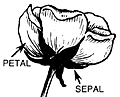
Usually green, sepals typically function as protection for the flower in bud, and often as support for the petals when in bloom.

basal -- at the base, situated or attached at the base.

Glands are plant structures that secrete liquids, salts or other substances. Glands often appear as hairs with a drop of liquid at the end.

fruit -- any seed-bearing structure in flowering plants. It is formed from the ovary after flowering.

acaulescent -- a plant that has no apparent stem, or at least none visible above ground.

stalk -- The supporting structure of an organ. Examples of stalks are stem, peduncle, petiole, ...

capitate -- having a knob-like head of flowers. Or a stigma with a pin head.

scape -- a long, leafless flower stalk coming directly from a root. The tulip has a scape.

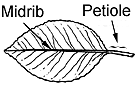
petiole -- the stalk of a leaf.

An inflorescence is a group or cluster of flowers arranged on a stem.

blade -- Just the flat part of a leaf. Not the stem.

glabrous -- smooth, glossy, having no bristles or hair-like structures. Bald.

alpine -- above the tree line. Thin soil, rocks, short growing season, frost, winter snow.