Al Schneider's Rocky Mountains Plant Descriptions

Slender Phlox
Microsteris gracilis
Phlox family (Polemoniaceae)

The plant was grown in England from seeds collected by David Douglas (of Douglas Fir fame) near "the banks of the Spoken River, and on high grounds near the Flathead River" (Quote from "Intermountain Flora"). In 1829 William Jackson Hooker named the plant Gilia gracilis and it has gone through numerous and species name changes since then. Edward Greene gave the presently accepted and species name in 1898. "Microsteris" is Greek for "small stem" and "" is Latin for "slender." Microsteris gracilis is often in the company of Blue-eyed Mary (Collinsia parviflora).


©2010 Walter Siegmund

Description

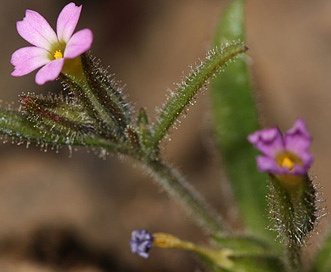
, early spring , 1-8" tall, with , hairy leaves 2-10" long, up to 1/4" wide. The red, oval shaped cotyledons are distinctive and often remain past blooming time. The lower leaves are , the upper . The white or pale pink flowers, 1/4-1/2" across, grow out of the leaf , often in pairs. The is shorter than the tube of the flower. are unequal in length and do not extend out of the tube.
Field Marks

Low, spring with hairy leaves and small white or pale pink flowers.

© Al Schneider

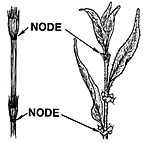
node -- The point at which there is attached growth, as in the place where each leaf is attached.

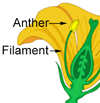
stamen -- the pollen-producing reproductive organ of a flower; The stamen consists of an anther supported by a filament.

A herb is a plant whose stems die back to the ground in the winter.

An annual plant is a plant that completes its life cycle, from germination to the production of seed, within one year, and then dies.

gracilis -- Slender.

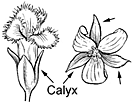
calyx -- the sepals of a flower, typically forming a whorl that encloses the petals and forms a protective layer around a flower in bud.

In an opposite leaf arrangement the leaves come in pairs with one leaf on each side of a stem.

leaves alternate along the main stem and are attached singly.

genus -- A subdivision of a botanical Family in which all members have a significant number of similar characteristics.

lanceolate -- Lance-shaped. Long, wider in the middle.