Al Schneider's Rocky Mountains Plant Descriptions

Colorado Four O'clock
Mirabilis multiflora
Verbena/Four-O'Clock family (Nyctaginaceae)

Four O'Clocks (Mirabilis multiflora) are most often found sprawling in the dry twigs and leaves under old Junipers. Mirabilis multiflora leaves are lustrous, thick, and large, easily catching a hiker's eye even before the attractive flowers bloom. Usually three buds are sheltered in the cup-like green . Each flower is about two inches across and three inches tall. and project above the . The plant's flowering is heavily dependent on getting just the right moisture. Commonly the plant produces a few sprawling branches with large leaves and just a few flowers, but when conditions are favorable huge showy mounds of leaves and flowers are produced. "Mirabilis" is Latin for "wonderful."


©2004 Curtis Clark
Description

Long-lived , clump-forming, typically three feet in diameter and one or two feet high. Stems 1-3' long, radiating from a root , along the ground and . Herbage green or , somewhat hairy to . Leaves with short , from a bit under 1" to 4" in diameter, to , , to . of or clusters, to 1/4" long, deeply 5-cleft. to over 1/3" long, pink to pink purple, rarely white. a .

Field Marks

Sprawling, mounded plant with large round leaves and large pink-purple flowers in clusters.

© Al Schneider

glaucous -- Pale gray or bluish-green. It can mean covered with a greyish, bluish or whitish coating.

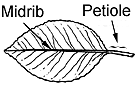
petiole -- the stalk of a leaf.

glabrous -- smooth, glossy, having no bristles or hair-like structures. Bald.

fused means joined together.

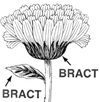
Bracts are modified leaves associated with a flower.

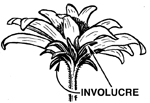
Involucre is the name given to the circle or spiral collection of bracts around a flower-cluster.

terminal -- Located at the end (the tip or the apex).

cordate -- heart-shaped.
subcordate -- somewhat heart-shaped.

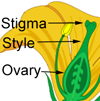
A pistil is the female structure of many flowers. It contains one or more carpels. Each carpel contins an ovary, style and stigma. The stigma receives the pollen which grows thru the style to reach the ovary.

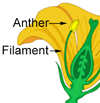
stamen -- the pollen-producing reproductive organ of a flower; The stamen consists of an anther supported by a filament.

An entire leaf has smooth edges. Not toothed or lobed.

truncate -- leaf with a squared-off end.

perianth -- the non-reproductive part of the flower such as petals and sepals.

orbicular -- Circular or nearly circular in outline.

ascending -- growing obliquely upward and usually curved.

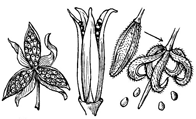
capsule -- a type of simple, dry fruit produced by many species of flowering plants. In most cases the capsule splits apart to release seeds.

fruit -- any seed-bearing structure in flowering plants. It is formed from the ovary after flowering.

An inflorescence is a group or cluster of flowers arranged on a stem.

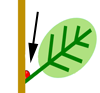
Axillary bud growing from the armpit of the plant.

A perennial plant lives and blooms for many years.

ovate -- Oval, egg-shaped, with a tapering point.

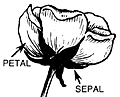
Usually green, sepals typically function as protection for the flower in bud, and often as support for the petals when in bloom.

canopy -- The foliage of a tree; the crown. Also the upper layer of a forest.

blade -- Just the flat part of a leaf. Not the stem.