Al Schneider's Rocky Mountains Plant Descriptions

Largeleaf Sandwort
Moehringia macrophylla
Pink family (Caryophyllaceae)

Large-leaf Sandwort (Moehringia macrophylla) grows in loose colonies arising from spreading roots. Plants grow from 4-12 inches tall scattered in moist forests. Leaves can have and minute hairs; flowers tend to droop from the ends of long . Moehringia macrophylla occurs in a few counties of southwest Colorado and northeast New Mexico. Moehringia macrophylla and the somewhat similar Catchfly (Silene menziesii) are quite similar; a comparison of leaves and flowers helps to separate the two.

William Hooker named this plant Arenaria macrophylla in 1830; Eduard Fenzl renamed it in 1833. Paul Moehring was an 18th century German botanist.


©2014 Steve Sullivan, Yan Soucie

Description

plants with stems from 4 to 12" tall, finely hairy. Leaves from 1 to 3+" long, or (even on same plant). Flower clusters or in upper axils, 1-5-flowered. Petals variable from somewhat longer to shorter than the , white. a 3-celled .

Field Marks

Short leafy plant in colonies; somewhat bell-shaped flowers and smooth to very finely hairy green leaves.

© Al Schneider

oblanceolate -- top wider than bottom

A perennial plant lives and blooms for many years.

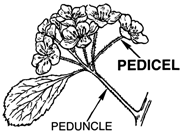
pedicel -- The stem of a single flower.

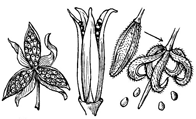
capsule -- a type of simple, dry fruit produced by many species of flowering plants. In most cases the capsule splits apart to release seeds.

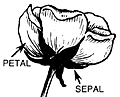
Usually green, sepals typically function as protection for the flower in bud, and often as support for the petals when in bloom.

terminal -- Located at the end (the tip or the apex).

fruit -- any seed-bearing structure in flowering plants. It is formed from the ovary after flowering.

scale -- A very small leaf around a dormant bud. Also other things that might remind one of fish scales on the surface of ferns, stems and the like.

montane -- inhabiting mountainous country but below timberline.

lanceolate -- Lance-shaped. Long, wider in the middle.