Al Schneider's Rocky Mountains Plant Descriptions

Tufted Evening-primrose
Oenothera cespitosa
Evening-Primrose family (Onagraceae)

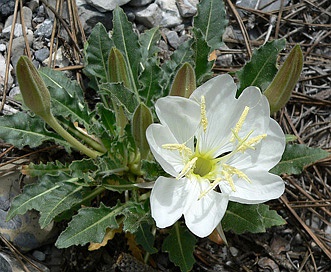
Individual flowers live less than a day; white petals turn pink with death. The flowers open in the late afternoon and evening to be pollinated by night-flying insects and they close with bright sunlight. Linnaeus named this in 1753 using the name "Oenothera" which was given several thousand years ago by Theophrastus to another in this family. "Caespitosa," "growing in tufts" refers to the dense tufts of and stems.


©2008 Stan Shebs

Description

Ground-hugging, stemless , 4-6" tall, with a of leaves with pointed tips. Large, white flowers have 4 heart-shaped petals and 8 yellow . are narrowly tapered to slender stems. The flowers open in late afternoon, close the next morning, and ultimately wither to pink or red-violet. roots often give rise to new plants.
Field Marks

Low-lying, showy white flowers, pink-purple flower buds.

© Al Schneider

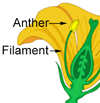
stamen -- the pollen-producing reproductive organ of a flower; The stamen consists of an anther supported by a filament.

rosette -- usually a dense cluster of leaves at the base of a plant.

A herb is a plant whose stems die back to the ground in the winter.

lateral -- attached to the side of an organ, for instance leaves or branches on a stem.

spatulate -- spoon-shaped.

basal -- at the base, situated or attached at the base.

basal leaves -- a leaf that grows lowest on the stem of a plant.

genus -- A subdivision of a botanical Family in which all members have a significant number of similar characteristics.

oblong -- Having an elongated form with somewhat parallel sides. Rectangular.

A perennial plant lives and blooms for many years.