Al Schneider's Rocky Mountains Plant Descriptions

Lavenderleaf Sundrop
Oenothera lavandulifolia
Evening-Primrose family (Onagraceae)

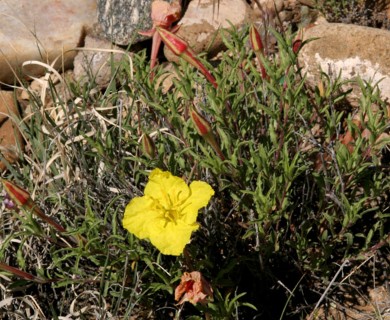
This member of the Evening Primrose Family at first appears to be a very close look-alike to some Oenotheras but the latter bloom in the evening and begin withering early in the morning whereas Calylophus lavandulifolia blooms during the day. Additionally distinctive are the color and texture of the long trumpet-like crinkly yellow petals. Flowers dry to shades of pink-orange-rust. Leaves are short and narrow with smooth edges. "Caly" is Greek for "" and "lophus" is Greek for "a crest," both referring to a small projection from the . "Lavandulifolia" refers to the lavender-like leaves. The first specimen of this plant was collected for science by Edwin James near the Platte River in Colorado in 1820 and the plant was then named Oenothera lavandulaefolia by Torrey and Gray in 1840; it was renamed Calylophus lavandulifolia by Peter Raven in 1964.

©2007 Patrick Alexander
Description

from a . Stems reclining to erect, less than an inch to 8 inches long and very narrow. Mound of leaves commonly to a foot in diameter. Flowers , solitary, distinctive erect pointed buds. to an inch. Petals 1/2 to 1" long, yellow or yellow orange, fading yellow or more commonly orange red. to almost an inch long.

Field Marks

Circular mass of small leaves topped by numerous distinctive buds and yellow flowers.

© Al Schneider

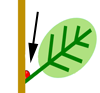
Axillary bud growing from the armpit of the plant.

A perennial plant lives and blooms for many years.

A herb is a plant whose stems die back to the ground in the winter.

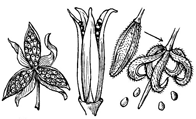
capsule -- a type of simple, dry fruit produced by many species of flowering plants. In most cases the capsule splits apart to release seeds.

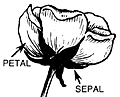
Usually green, sepals typically function as protection for the flower in bud, and often as support for the petals when in bloom.

taproot -- The primary decending root of a plant.

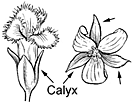
calyx -- the sepals of a flower, typically forming a whorl that encloses the petals and forms a protective layer around a flower in bud.