Al Schneider's Rocky Mountains Plant Descriptions

Plains Prickly Pear
Opuntia polyacantha
Cactus family (Cactaceae)

The several prickly pear cacti in our area hybridize and precise identification is often difficult. Many-spined Prickly Pear Cactus forms mats to five feet across. Flowers may be peach-colored, yellow, or pink. Prickly pear are edible eaten raw or cooked. In addition to obvious , the various prickly pear cacti have minute barbed hairs () that are difficult to see and remove from skin. The name "Opuntia" was used by Theophrastus for a plant (not in the Cactus Family), which grew near the Greek town of Opus. Somehow "Opuntia" was centuries later applied to this of Cacti in North America. "Polyacantha" means "many ."
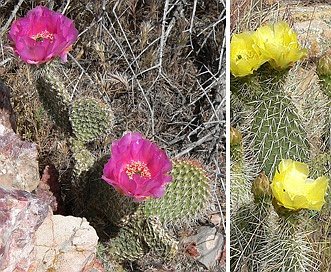

©2007 Stan Shebs

Description

Spiny , 4-20'' high, forming spreading clumps. Rounded succulent pads are covered with bundles of straight 2-5" that may be slightly barbed. Very short, stiff brown hairs arise from few . Yellow flowers with overlapping petals arise from buds on margins of pads. Pear-shaped , about 1" wide, are fleshy and short-spiny.

Field Marks

Relatively round fleshy pads with long straight and large showy yellow flowers.

© Al Schneider

areoles are small light or dark-colored bumps in cactus containing spines. Areoles are also island-like pieces of lichen.

A perennial plant lives and blooms for many years.

spine -- a stiff, sharp structure formed by the modification of a plant organ that contains vascular tissue. A spine can be formed by a latteral branch, a modified leaf or a thorn.

A herb is a plant whose stems die back to the ground in the winter.

fruit -- any seed-bearing structure in flowering plants. It is formed from the ovary after flowering.

Glochids are tiny barbed hairs which grow from areoles of cacti. Cactus glochids easily detach from the plant and lodge in the skin, causing irritation upon contact.

genus -- A subdivision of a botanical Family in which all members have a significant number of similar characteristics.