Al Schneider's Rocky Mountains Plant Descriptions

Smallflower Miterwort
Ozomelis stauropetala
Saxifrage family (Saxifragaceae)

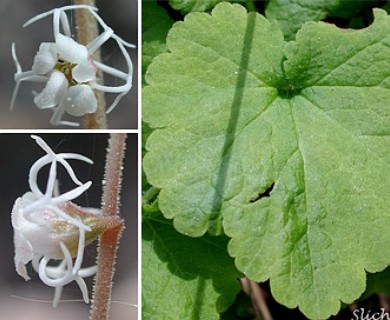
The leaves of Mitrewort are large, showy, and reminiscent of Brook Saxifrage, and the tall slim flower is also, at first glance, similar to that of Brook Saxifrage. The flowers of each plant are exquisite miniature works of beauty but quite different from each other, as are the habitats of the two plants: Mitrewort occurs in woodlands; Brook Saxifrage occurs along water. Small Mitrewort (Pectiantia pentandra is even more easily mistaken for Mitrewort but the latter is taller, has white flowers vs. green and red; has smoother leaves; is usually in smaller patches; its flowers are (all on one side of the flowering stem). Both plants enjoy similar habitats and can often be found near each other, but both can be difficult to find because they are usually buried in a mass of other greenery.

"Stauro" is Greek for "-like," referring to the tiny branchings of the petals and "Pentandra" is from the Greek for "five ." Linnaeus named the Mitella in 1753. Charles Piper named Mitella stauropetala in 1899 from specimens Sandberg, Mac Dougal, and Heller collected in Idaho in 1892. "Mitella" is Latin for "turban."

©2008 Paul Slichter
Description

Slender plants with scaly rootstocks, commonly to 18" tall, throughout or just below. Leaves rather long-petioled. Leaf round with rounded along the margin and shallowly . elongated, flowers usually to one side, short. white, petals about twice as long as the , 3-parted for half of their length into very narrow divisions. alternate with the petals and opposite the . a .

Field Marks

Few with long, narrow flower stem supporting tiny, horizontal, white, spider-like white flowers.

© Al Schneider

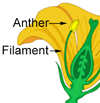
stamen -- the pollen-producing reproductive organ of a flower; The stamen consists of an anther supported by a filament.

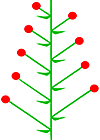
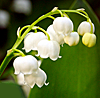
A raceme is an unbranched, indeterminate type of inflorescence bearing flowers having short floral stalks along its axis.

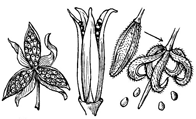
capsule -- a type of simple, dry fruit produced by many species of flowering plants. In most cases the capsule splits apart to release seeds.

A perennial plant lives and blooms for many years.

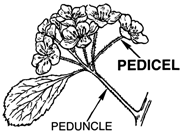
pedicel -- The stem of a single flower.

lobe -- A rounded parts of a leaf (or other organ).

cross -- To make something interbreed. The act of hybridization.

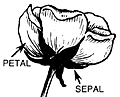
Usually green, sepals typically function as protection for the flower in bud, and often as support for the petals when in bloom.

basal -- at the base, situated or attached at the base.

Glands are plant structures that secrete liquids, salts or other substances. Glands often appear as hairs with a drop of liquid at the end.

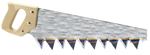
Like the teeth on a saw, leaves and other surfaces can have toothed edges.

fruit -- any seed-bearing structure in flowering plants. It is formed from the ovary after flowering.

stalk -- The supporting structure of an organ. Examples of stalks are stem, peduncle, petiole, ...

The anther is a pad at the end of the stamen that holds the pollen.

scape -- a long, leafless flower stalk coming directly from a root. The tulip has a scape.

secund -- With all of the flowers on one side. Having all parts arranged on one side.

genus -- A subdivision of a botanical Family in which all members have a significant number of similar characteristics.

blade -- Just the flat part of a leaf. Not the stem.

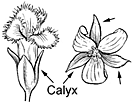
calyx -- the sepals of a flower, typically forming a whorl that encloses the petals and forms a protective layer around a flower in bud.

lobe -- Being divided by clefts.