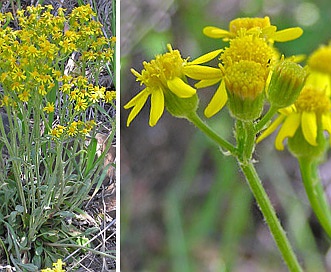
New Mexico Groundsel Packera neomexicana Aster family (Asteraceae)
Members of the Packera are common in Colorado and nearby mountain ranges, but species are difficult to distinguish because they hybridize. The very common Packera neomexicana is especially variable, having many forms. P. neomexicana enjoys dry hillsides and and can produce an abundance of flowers on each plant and an abundance of plants in a small area. The elongated stem with a mound of and few, small stem leaves is characteristic. Charles Wright collected the first specimens of this plant for science in New Mexico and the plant was first named Senecio neomexicanus by Asa Gray in 1884. William Weber renamed it Packera neomexicana in 1981.
(or ) from a . Stems 6 to 16" tall, erect. Herbage gray or white hairy. and lower with , the 2/5 to 2" long and up to almost an inch wide, to or oval, , , or ; most often shallowly , or , or at the tip. reduced upward on the stem, to or . Flowerheads few to many, clustered. about 1/4" high and 1/5 to 1/2" wide, main 13-21, green or brown. 8-13, yellow, from 1/6 to 2/5" long. white. an .
achene -- a type of simple dry fruit produced by many species of flowering plants.
For example, a rose hip holds a few achenes.
taproot -- The primary decending root of a plant.
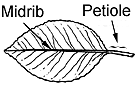
petiole -- the stalk of a leaf.
meadow -- Large grass and wildflower filled area with few, if any, trees.
cauline leaves -- leaves growing on a stem and especially on the upper part.
ray flowers -- The outer petals of a sunflower or daisy are ray flowers.
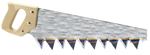
serrate -- toothed with asymmetrical teeth pointing forward; like the cutting edge of a saw.
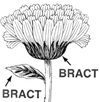
Bracts are modified leaves associated with a flower.
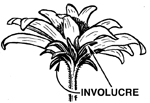
Involucre is the name given to the circle or spiral collection
of bracts around a flower-cluster.
Like the teeth on a saw, leaves and other surfaces can have toothed edges.
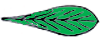
obovate -- Teardrop-shaped, stem attaches to tapering point.
An entire leaf has smooth edges. Not toothed or lobed.
oblanceolate -- top wider than bottom
A herb is a plant whose stems die back to the ground in the winter.
basal leaves -- a leaf that grows lowest on the stem of a plant.
spatulate -- spoon-shaped.
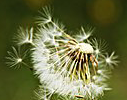
pappus -- Small scales, bristles or hairs at the top of the seed in Asteraceae. For example,
dandelion parachutes. Plural: pappi.
basal -- at the base, situated or attached at the base.
fruit -- any seed-bearing structure in flowering plants.
It is formed from the ovary after flowering.
A perennial plant lives and blooms for many years.
biennial -- a plant which lives for two years, producing a basal rosette of leaves
the first year and a full plant, flower, and seed the second year followed by
the death of the entire plant at the end of the second year.
genus -- A subdivision of a botanical Family in which all members have a significant
number of similar characteristics.
blade -- Just the flat part of a leaf. Not the stem.