Al Schneider's Rocky Mountains Plant Descriptions

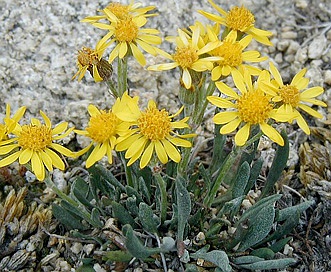
Hoary Groundsel
Packera werneriifolia
Aster family (Asteraceae)

(Packera werneriifolia is, in the manner of most Packera, highly variable. It is typically found above tree-line in rocky soils. It often forms foot diameter tight clusters of numerous dark green leaves and dozens of yellow and gold flowers, and it frequently is in the company of Senecio fremontii which also forms a dense mat topped by very similar appearing flowers. S. fremontii can be distinguished from P. werneriifolia by carefully observing the leaves: those of S. fremontii are light green, , prominently , and succulent appearing. Those of P. werneriifolia are dark green, petioled, finely , and thinner. "Werneriifolia" means "with leaves similar to those of the Asteraceae , Werneria," a species not found in the United States. Abraham Werner (1749-1817) was a German geologist. Hall and Harbour collected this species in Colorado in 1862 and in 1864 Asa Gray named it Senecio aureus, variety werneriaefolius, changing it to Senecio werneriaefolius in 1883. In 1981 Weber and Love published their reasoning for changing the to "Packera." John Packer is a Canadian botanist.

©2009 Barry Breckling
Description

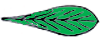
Plants commonly . Stems erect 1 to 6" tall. Herbage densely to thinly hairy, often or with age. , the 1/4 to 1"+ wide oval to , , or , thick sometimes . few, or greatly reduced. Flowerheads 1-4, 1/6 to 2/5 " long and 1/4 to over 1/2" wide. Main 13-21, green or suffused with purple, tuft of hairs at tip. Outer to half as long as inner. 8-13, yellow, from 1/6 to 2/5" long. hairs white. a .

Field Marks

Low, matted spreading plant with shiny green with long ; topped by numerous yellow flowers.

© Al Schneider

ray flowers -- The outer petals of a sunflower or daisy are ray flowers.

petiolate -- a leaf that has a stem. A sessile leaf has no stem.

oblanceolate -- top wider than bottom

cauline leaves -- leaves growing on a stem and especially on the upper part.

achene -- a type of simple dry fruit produced by many species of flowering plants. For example, a rose hip holds a few achenes.

A herb is a plant whose stems die back to the ground in the winter.

obovate -- Teardrop-shaped, stem attaches to tapering point.

revolute -- With margins rolled backward and under onto the lower side of a leaf.

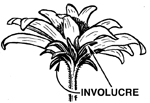
Involucre is the name given to the circle or spiral collection of bracts around a flower-cluster.

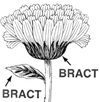
Bracts are modified leaves associated with a flower.

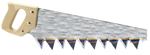
Like the teeth on a saw, leaves and other surfaces can have toothed edges.

fruit -- any seed-bearing structure in flowering plants. It is formed from the ovary after flowering.

sessile -- attached without a stalk. For example, a leaf that clasps the stalk. A petiolate leaf has a stalk.

elliptic -- Oval, with no point or a very short point.

basal leaves -- a leaf that grows lowest on the stem of a plant.

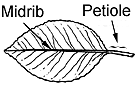
petiole -- the stalk of a leaf.

genus -- A subdivision of a botanical Family in which all members have a significant number of similar characteristics.

blade -- Just the flat part of a leaf. Not the stem.

glabrous -- smooth, glossy, having no bristles or hair-like structures. Bald.

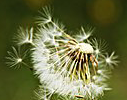
pappus -- Small scales, bristles or hairs at the top of the seed in Asteraceae. For example, dandelion parachutes. Plural: pappi.

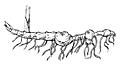
rhizome -- root-like stems that may either grow horizontally at the soil surface or in other orientations underground.