Al Schneider's Rocky Mountains Plant Descriptions

Fivestamen Miterwort
Pectiantia pentandra
Saxifrage family (Saxifragaceae)

The leaves of Pectiantia pentandra are characteristic of many members of the Saxifrage Family. Flower stalks of Pectiantia pentandra are often about six-to-eight inches long and flowers are tiny works of wispy art: green, filamentary, and airy. The plant is less commonly noticed than its close cousin, Ozomelis stauropetala even though the two enjoy the same habitat and do grow very near each other in wetlands, moist woods, and shady areas of spruce forests. Observing this flower closely may get you wet and muddy but you will be filled with wonder. "Pectiantia" is perhaps from the Greek for "comb" "Pentandra" is from the Greek for "five ." William Jackson Hooker named Mitella pentandra in 1829 from plants that had been grown from seeds Thomas Drummond collected in the northern Rockies. Per Axel Rydberg renamed this plant Pectiantia pentandra in 1905.
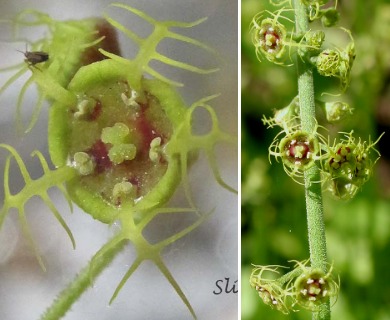

© Paul Slichter
Description

Delicate with slender, leafless stems 6-14" tall. Its leaves are heart-shaped in outline, 1-2.5" wide and divided into 5 to 9 shallow, . Green, saucer-shaped flowers are loosely clustered in a -like arrangement. Each flower is composed of 5 to spreading and 5 petals that are divided into 7 to 9 thread-like . At the center are 5 stubby at the base of each petal.

Field Marks

Delicate with leafless flowering stems; green, saucer-shaped flowers loosely arranged in an elongated cluster; petals divided into 7 to 9 thread-like .

© Al Schneider

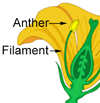
stamen -- the pollen-producing reproductive organ of a flower; The stamen consists of an anther supported by a filament.

A perennial plant lives and blooms for many years.

lobe -- A rounded parts of a leaf (or other organ).

A herb is a plant whose stems die back to the ground in the winter.

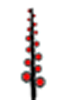
A spike is an unbranched, indeterminate inflorescence in which the flowers are without stalks.

reflexed -- bent sharply back or down.

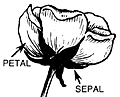
Usually green, sepals typically function as protection for the flower in bud, and often as support for the petals when in bloom.

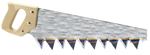
Like the teeth on a saw, leaves and other surfaces can have toothed edges.

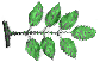
pinnate -- A compound leaf with two rows of leaflets.

The anther is a pad at the end of the stamen that holds the pollen.

palmate -- Consisting of leaflets or lobes radiating from the base of the leaf.