Al Schneider's Rocky Mountains Plant Descriptions

Bracted Lousewort
Pedicularis bracteosa
Broomrape/Paintbrush family (Orobanchaceae)

Fernleaf Lousewort is commonly found in scattered groups of a dozen or more plants. Distinctive, candle-like stalks rise above surrounding vegetation. This species is easily confused with its taller cousin, Giant Lousewort (Pedicularis procera); the latter often grows to 4' and its larger flowers have streaks of rusty orange. Fernleaf Lousewort might also be confused with Parry's Lousewort, but the latter is shorter, has lighter colored flowers, and occurs at high and elevations. The Figwort Family typically has and petals forming a tube-like flower. The name, "Pedicularis," given by Linnaeus in 1753, is derived from the Latin "pediculus," meaning "lice." A bygone belief had it that the plant gave lice to people and cattle. Or, according to some sources, the plant was thought to cure people or cattle of lice! "Wort" is from the Old English, "wyrt," meaning "plant."
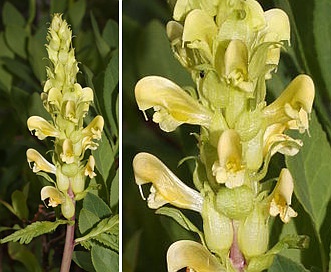

©2007 Walter Siegmund

Description

Erect, stout , 20-36" tall, with delicate fern-like leaves and a tall flower bearing light yellow flowers in -like clusters atop leafy, unbranched stems. Flowers are -like. , , to , and doubly with uppermost leaf segments smaller and joined.

Field Marks

Tall of yellow flowers atop large fern-like leaves.

© Al Schneider

fused means joined together.

A perennial plant lives and blooms for many years.

pinnatifid -- A leaf shape that is pinnately lobed but not cut all the way to the axis.

A herb is a plant whose stems die back to the ground in the winter.

subalpine -- Just below the timberline.

beak -- A pointy thing on a seed or fruit.

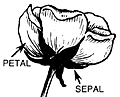
Usually green, sepals typically function as protection for the flower in bud, and often as support for the petals when in bloom.

linear-oblong -- Extremely compressed-elliptic, the sides apprximately parallel from near one end to the near the other.

Like the teeth on a saw, leaves and other surfaces can have toothed edges.

stalk -- The supporting structure of an organ. Examples of stalks are stem, peduncle, petiole, ...

lanceolate -- Lance-shaped. Long, wider in the middle.

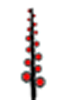
A spike is an unbranched, indeterminate inflorescence in which the flowers are without stalks.

genus -- A subdivision of a botanical Family in which all members have a significant number of similar characteristics.

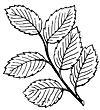
leaves alternate along the main stem and are attached singly.

alpine -- above the tree line. Thin soil, rocks, short growing season, frost, winter snow.