Al Schneider's Rocky Mountains Plant Descriptions

Mountain Cactus
Pediocactus simpsonii
Cactus family (Cactaceae)

This lovely, symmetrical ball of is fairly common from Sagebrush areas to the upper limits of Pinyon/Juniper forests. Flowers are white, pink, yellow, and/or green. are smooth, radial are white, and the central (s) is brown to black. The plant was first collected for science in Nevada by J. H. Simpson who made a number of western exploratory expeditions as a Topographical Engineer. Simpson gave the plant to George Engelmann, an eminent 19th century botanist and cactus expert, Engelmann recognized it as a new species, and he named it Echinocactus simpsonii in 1863. In 1913 Nathaniel Britton and Joseph Rose created a new , Pediocactus, and placed this plant in it. "Pedio" means "plains."
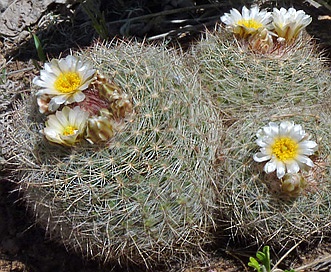

©2009 Al Schneider

Description

Plants to 6" in diameter, globular, single or often colonial. to 1" long. to almost circular. Central usually 4-10, from 1/5 to 1" long, brown or black. Radial mainly 10-25, white. Flowers to over 1" long, white, pink , yellow, green, fringed. green often turning red brown.

Field Marks

Symmetrical ball of with one inch pink white flowers.

© Al Schneider

areoles are small light or dark-colored bumps in cactus containing spines. Areoles are also island-like pieces of lichen.

spine -- a stiff, sharp structure formed by the modification of a plant organ that contains vascular tissue. A spine can be formed by a latteral branch, a modified leaf or a thorn.

tubercle is generally a wart-like projection.

fruit -- any seed-bearing structure in flowering plants. It is formed from the ovary after flowering.

elliptic -- Oval, with no point or a very short point.

genus -- A subdivision of a botanical Family in which all members have a significant number of similar characteristics.