Al Schneider's Rocky Mountains Plant Descriptions

Whipple's Penstemon
Penstemon whippleanus
Plantain family (Plantaginaceae)

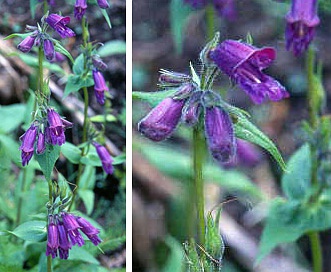
On walks along high mountain trails it is common to see a tall plant that appears to have tiny purple flowers at its very top. A closer look shows these purple splashes of color to be minute, drooping, thin buds. They puzzle wildflower admirers, but once the buds swell and burst open there is no question. Whipple's Penstemon (Penstemon whippleanus) has about as rich a color and as showy a cluster as any flower. A close look at the flower will show silvery white stripes through the purple and a multitude of shining hairs on the flower surface. The hairs impart a silvery sheen to the sunlit flowers. In certain areas flower color can also range from white to light blue.

Penstemon whippleanus was collected by John Bigelow in the Sandia Mountains near present-day Albuquerque in 1853, and it was named by Asa Gray in 1862. Bigelow, who has a number of plants named for him, was a member of Lt. Amiel Whipple's expedition surveying for a transcontinental railroad route along the 35th parallel.

©2004 Robert Sivinski
Description

typically to 20" tall but as much as 40", herbage below, becoming with spreading white hairs in the . Stems slender usually erect, clustered. Leaves to 5" long and 1 1/2" wide, thin, to , , the ones abruptly narrowed to a slender , the upper . of 2-4 swirls of flowers with 1-5 flowers. Flowers spreading- to . densely . to over an inch long, , the abruptly expanded from a short tube, upper lip spreading, lower one projecting and exceeding the upper, conspicuously bearded with long white hairs, dark blue or wine purple to dull lavender or blue white. sometimes , sacs blue. a .

Field Marks

Dense colony of stems with somewhat drooping, usually dark wine-colored flower clusters.

© Al Schneider

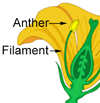
stamen -- the pollen-producing reproductive organ of a flower; The stamen consists of an anther supported by a filament.

An entire leaf has smooth edges. Not toothed or lobed.

exserted -- projected beyond. (Exserted stamens project beyond the corolla tube.)

A perennial plant lives and blooms for many years.

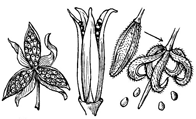
capsule -- a type of simple, dry fruit produced by many species of flowering plants. In most cases the capsule splits apart to release seeds.

A herb is a plant whose stems die back to the ground in the winter.

The anther is a pad at the end of the stamen that holds the pollen.

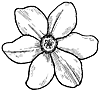
corolla -- The name for all the petals of a flower taken together.

throat -- The opening of a flower.

reflexed -- bent sharply back or down.

basal -- at the base, situated or attached at the base.

Glands are plant structures that secrete liquids, salts or other substances. Glands often appear as hairs with a drop of liquid at the end.

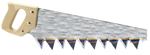
Like the teeth on a saw, leaves and other surfaces can have toothed edges.

fruit -- any seed-bearing structure in flowering plants. It is formed from the ovary after flowering.

sessile -- attached without a stalk. For example, a leaf that clasps the stalk. A petiolate leaf has a stalk.

hanging or drooping.

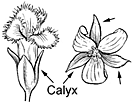
calyx -- the sepals of a flower, typically forming a whorl that encloses the petals and forms a protective layer around a flower in bud.

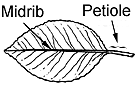
petiole -- the stalk of a leaf.

glabrous -- smooth, glossy, having no bristles or hair-like structures. Bald.

lanceolate -- Lance-shaped. Long, wider in the middle.

An inflorescence is a group or cluster of flowers arranged on a stem.