Al Schneider's Rocky Mountains Plant Descriptions

Rock Goldenrod
Petradoria pumila
Aster family (Asteraceae)

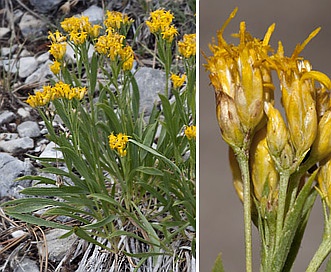
Rock Goldenrod (Petradoria pumila) is a very common plant found in extensive colonies lining trails and roads and filling . It first attracts attention to itself in early summer with bright green, dense, six inch diameter clusters of vertical leaves. Then, in mid-summer its four-to ten inch stems are topped with a mass of tiny, attractive, golden/yellow flowers. The base of the plant has a whorl of gray dead leaves from the previous year's growth. This whorl could be confused with the very similar whorl of Stenotus armerioides. Petradoria pumila is also confused with Broom Snakeweed (Gutierrezia sarothrae) but the latter usually blooms later in August and September and is taller, woody, bright yellow, in more rounded clusters with very narrow, short leaves.

"Petra" is from the Greek for "rock: and "doria," is, a past name for a Goldenrod. "" is Latin for "dwarf." A specimen of this plant was first collected for science by Thomas Nuttall "in open situations on shelving rocks" in the Rockies.

©2014 Richard Spellenberg
Description

Plants from a well-developed (woody base of non-woody ) with branches clothed with dry dead leaf bases. Leaves 1/2 to 5" long and from 1/25 to 1/2" wide, to , , or . reduced upward on the stem. Flowerheads numerous and tiny. 10-21 in 3-6 series, somewhat . Flowers 2-8, the 1-3, yellow, 1/6 to 1/3" long. an 1/5" long, , 6-9 .

Field Marks

Neat 5" diameter cylindrical clusters of stems typically to about 8" tall topped by golden yellow of numerous tiny flowers.

© Al Schneider

ray flowers -- The outer petals of a sunflower or daisy are ray flowers.

oblanceolate -- top wider than bottom

pumila -- Dwarf, small.

meadow -- Large grass and wildflower filled area with few, if any, trees.

cauline leaves -- leaves growing on a stem and especially on the upper part.

fruit -- any seed-bearing structure in flowering plants. It is formed from the ovary after flowering.

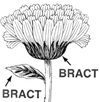
Bracts are modified leaves associated with a flower.

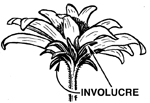
Involucre is the name given to the circle or spiral collection of bracts around a flower-cluster.

achene -- a type of simple dry fruit produced by many species of flowering plants. For example, a rose hip holds a few achenes.

linear -- Long and very narrow like a blade of grass.

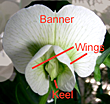
In a pea flower the two bottom petals are fused together forming a boat-like structure called the keel. The glumes of grasses may have a sharp projecting ridge like the keel of a boat.

elliptic -- Oval, with no point or a very short point.

canopy -- The foliage of a tree; the crown. Also the upper layer of a forest.

caudex -- The woody stem base of some herbaceous perennials.

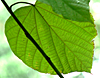
nerves -- Another name for a vein.

glabrous -- smooth, glossy, having no bristles or hair-like structures. Bald.

lanceolate -- Lance-shaped. Long, wider in the middle.

A perennial plant lives and blooms for many years.