Al Schneider's Rocky Mountains Plant Descriptions

Double Bladderpod
Physaria acutifolia
Mustard family (Brassicaceae)

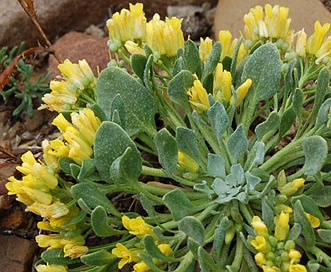
Double Bladderpod is a common plant of the lower foothills and canyons in western Colorado. Its silvery green clusters of are a common site year-round, often dotting the ground. Typically the plant is not more than 2-3 inches in diameter and 4" tall, but it can be 4 times these dimensions. There are a number of Physarias (Bladderpods) in our region; Physaria acutifolia is probably the most common. Although the various Physaria are short plants, their abundance of bright yellow flowers attracts attention. Physaria pulvinata and Physaria rectipes are just two of many more that have the bright yellow flowers, seed pods, and low growth pattern characteristic to this . The was named by Asa Gray in 1848 and is now greatly expanded with the addition of all former members of the Lesquerella . "Physaria" is Greek for "bladder."

©2009 Tony Frates

Description

, , leaf bases. Stems one to few, 1-8" long, to or erect, unbranched. to 4" long and nearly 2" wide but commonly a bit more than 1" long and 1" wide. The are typically spoon-shaped, , and very hairy. Stem leaves tiny, . less than 1" long. no more than 1/3" long, petals to 1/2" long, yellow. double bladder, green to purple.

Field Marks

Small of silvery green hairy leaves topped by short stems of numerous, small, bright yellow flowers.

© Al Schneider

An entire leaf has smooth edges. Not toothed or lobed.

genus -- A subdivision of a botanical Family in which all members have a significant number of similar characteristics.

A perennial plant lives and blooms for many years.

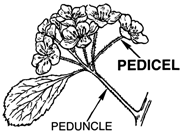
pedicel -- The stem of a single flower.

caespitose -- Grass (or plants) growing in small dense clumps or tufts.

persistent -- When the leaves of a plant fail to fall off in the fall they are persistent. Flowers that stay around after fruiting would be persistent.

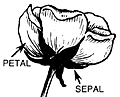
Usually green, sepals typically function as protection for the flower in bud, and often as support for the petals when in bloom.

ascending -- growing obliquely upward and usually curved.

basal -- at the base, situated or attached at the base.

fruit -- any seed-bearing structure in flowering plants. It is formed from the ovary after flowering.

basal leaves -- a leaf that grows lowest on the stem of a plant.

decumbent -- with branches growing horizontally on the ground, but turned up at the ends.

inflated -- Swollen. Looks unusually large.

rosette -- usually a dense cluster of leaves at the base of a plant.