Ponderosa Pine Pinus ponderosa Pine family (Pinaceae)
Ponderosa Pine is a majestic tree, often towering over other low-growing pines and junipers. It is the most widely distributed pine in North America, virtually outlining the American West. The name refers to the ponderous or heavy wood. Ponderosa Pine reaches maturity in 300 to 400 years. The wood is highly desirable as saw timber. The bark of mature Ponderosa Pines is cinnamon to yellow/orange in a fascinating jig-saw pattern; the characteristic bark lends the tree another common name, Yellow Pine. When heated by the sun, Ponderosa Pine bark exudes a most pleasant soft vanilla/butterscotch fragrance. The layer upon layer of bark gives the trees enhanced fire protection. David Douglas (of Douglas Fir fame) was the first to describe Pinus ponderosa after collecting it (probably in his 1825-1827 North America travels) in the present state of Washington.
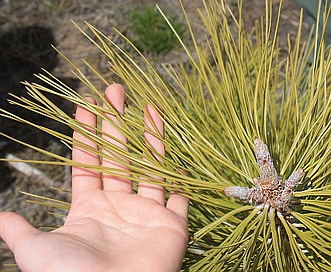
Coniferous tree, up to 140' tall. Needles in bundles of 3, averaging seven inches in length (5-10"), tufted at the end of branches. Bark is gray to black on young trees. As the tree matures, the bark thickens to as much as four inches and breaks into large, flat, yellow-brown scaly plates separated by deep furrows. The bark flakes off in small, irregular pieces resembling jigsaw puzzle pieces and has a fragrance of vanilla or butterscotch. Female seed cones are egg-shaped, 3-6" in length (average 4") when mature. The tips of the cone are armed with short, sharp, out-curved prickles. The male cones are small, yellow, and in clusters. Buds are resinous, red-brown, and about 0.5" long. The tree has a long clear trunk, its branches are self-pruning, rising to a high short open .