Al Schneider's Rocky Mountains Plant Descriptions

Balsam Poplar
Populus balsamifera
Poplar-Willow family (Salicaceae)

Cottonwoods get their common name from the cottony hairs that carry the seeds that fill the air with white snowy cotton. Balsam Poplars flash silvery when the wind stirs their leaves. Leaf buds are coated with a sweet-smelling resin often called balsam. Balsam Poplar commonly hybridizes with other cottonwoods. Narrowleaf Cottonwood (P. angustifolia), with its narrowly leaves, is also found in the region. The Eastern Cottonwood (P. deltoides), with its large leaves, is found not only from the Great Plains eastward but also throughout the West. There are several .
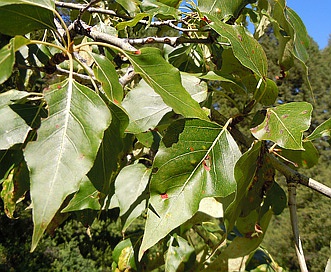

©2010 Matt Lavin

Description

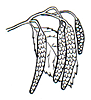
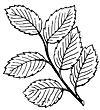
tree, growing to 60' tall with an oval-shaped and straight, branch-free trunk. Bark is smooth and green on young stems, becoming gray and furrowed with age. Leaves are , , triangular to , 3-7" long and 3-4" wide, thick, leathery, rounded at the base, shiny green on top and whiter below. bud are sticky. Male and female flowers borne in on same tree. Seeds bear enclosed in cotton-like hairs that promote wind and water dispersal.

Field Marks

Triangular- or leaves, cottony , furrowed bark, near water.

© Al Schneider

hastate -- spear-shaped. Pointed, with barbs, shaped like a spear point, with flaring pointed lobes at the base.

A catkin is a tight cylindrical flower cluster where flowers connect directly to a stem. The flowers generally don't have petals and the stem is often drooping.

ovate -- Oval, egg-shaped, with a tapering point.

A simple leaf blade is one that is not divided into separate leaflets.

terminal -- Located at the end (the tip or the apex).

Deciduous plants are those that lose all of their leaves for part of the year.

scale -- A very small leaf around a dormant bud. Also other things that might remind one of fish scales on the surface of ferns, stems and the like.

deltoid -- a triangular leaf shape. The stem attaches to the middle of a flat side.

subspecies -- Plants within a species can be divided into two or more supspecies when a botanist gives them subspecies names and describes how the subspecies differ. Often, variety and subspecies are used interchangeably.

alternate -- leaves alternate along the main stem and are attached singly.

canopy -- The foliage of a tree; the crown. Also the upper layer of a forest.