Quaking Aspen
Populus tremuloides
Poplar-Willow family (Salicaceae)
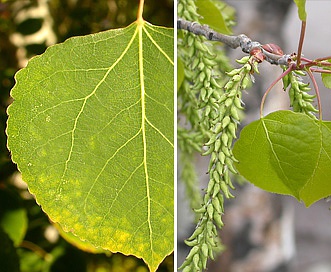
An iconic tree of the Rockies and all of northern North America. The shimmering leaves and white bark of Aspen provide a vivid contrast to the surrounding conifer forest. The flat, narrow leaf allows leaves to "tremble" or "quake" in the slightest breeze. Leaves turn deep yellow in fall. The Aspen's ecology presents a number of paradoxes. It is typically a successional species in the West, dependent upon disturbance (primarily fire) for regeneration, yet Aspens form climax communities in some locations. While individual Aspen "ramets" (trunks sprouted vegetatively) are among the shortest-lived trees in western forests, a continuous clone of Aspen can be an incredibly long-lived. Evidence suggests that well-established clones date back 1 million years. "Populus" is a classical Latin tree name given to this by Linnaeus in 1753. The Greek ending "oides" indicates "resemblance" and "tremuloides" thus means "resembling the species Populus tremula." "Trem" is Latin for "trembling," used here to describe the manner in which the leaves of both these species quiver in the slightest breeze.
©2006 Matt Lavin