Al Schneider's Rocky Mountains Plant Descriptions

Rough-fruited Fairybells
Prosartes trachycarpa
Lily family (Liliaceae)

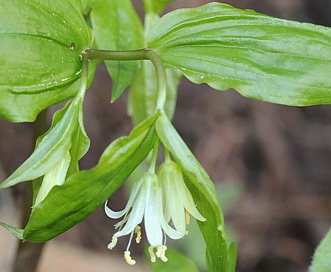
Fairybells typically hold their leaves horizontally, which hides the very delicate flower or . The Blackfeet Indians placed Fairybell in their eyes overnight as a treatment for snow blindness. The dampened leaves were also used as a bandage. David Don (1799-1841) named this in 1839, and Sereno Watson named this species Prosartes trachcarpa in 1871 from specimens he collected in Utah in 1871. The Disporum trachycarpum name was given by Bentham and Hooker in 1883. "Prosartes," Greek, means "fastened" and somehow refers to the manner in which the parts are attached. "Trachycarpum" is also Greek and means "rough ." This species has some similarities with Twisted but the latter is much taller with round .

©2013 Paul Slichter
Description

, 1-2' tall, with narrow bell-shaped flowers, strongly nodding and often in pairs. Delicate creamy-white flowers arise from end of stems and consist of 6 spreading from the base with 6 yellow that typically extend just beyond the . Leaves are - and pointed at tip. Leaves have prominent veins that run parallel to the leaf margin and clasp stem. A pair of leaves often obscures the flowers. consist of 1-3 red-orange round with a velvety, warty skin.

Field Marks

Hanging bell-shaped white flowers or bright yellow-red lumpy with alternate egg- or leaves.

© Al Schneider

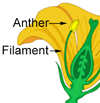
stamen -- the pollen-producing reproductive organ of a flower; The stamen consists of an anther supported by a filament.

A perennial plant lives and blooms for many years.

A herb is a plant whose stems die back to the ground in the winter.

ovate -- Oval, egg-shaped, with a tapering point.

terminal -- Located at the end (the tip or the apex).

fruit -- any seed-bearing structure in flowering plants. It is formed from the ovary after flowering.

stalk -- The supporting structure of an organ. Examples of stalks are stem, peduncle, petiole, ...

The botanical term "berry" is different from common usage. Strawberries and raspberries are not berries. But a tomatoe is. A true berry is a fruit with the seeds immersed in the pulp.

tepal -- like a flower petal. Tepal is used, instead of petal, when it is not easy to tell the sepals from the petals.

genus -- A subdivision of a botanical Family in which all members have a significant number of similar characteristics.

alternate -- leaves alternate along the main stem and are attached singly.

lanceolate -- Lance-shaped. Long, wider in the middle.

oblong -- Having an elongated form with somewhat parallel sides. Rectangular.