Al Schneider's Rocky Mountains Plant Descriptions

Tuber Starwort
Pseudostellaria jamesiana
Pink family (Caryophyllaceae)

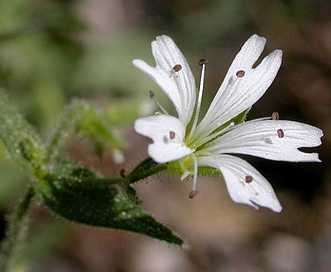
Tuber Starwort most often occurs in clusters in scattered patches because it spreads and sprouts from underground tubers. You will find the plant in drier lowlands and in moist forests. Plants usually grow narrowly erect with narrow, pointed leaves standing out at stiff right angles from the stem and leaf tips gently curved downward. Tuber Starwort is tall for a chickweed, commonly growing from eight to fourteen inches. "Pseudostellaria" refers to Starwort's resemblance to the Stellaria of Caryophyllaceae. The Pseudostellaria was named by Ferdinand Pax in 1934. "Jamesiana" is for the naturalist Edwin James, famed botanist of the 1819-1820 Long Expedition, the first Caucasian plant collector in Colorado and the central Rockies, and the first to climb Long's Peak, which was originally named "James' Peak."

©2009 Keir Morse
Description

from , these often with tuberous thickenings; stems 4-24" tall with horizontal leaves, narrow to 5" long. open, , flowers solitary or more commonly several on to two inches long. green, . Petals about 1/4" long, white, two-. a , opening by 3 . Seeds dark brown, wrinkled.

Field Marks

Tall, gangly plant with very narrow, horizontal leaves with downturned tips, white flowers with notched petals.

© Al Schneider

A perennial plant lives and blooms for many years.

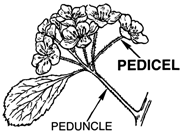
pedicel -- The stem of a single flower.

A herb is a plant whose stems die back to the ground in the winter.

valve -- A portion of an organ that fragments or splits open.

An inflorescence is a group or cluster of flowers arranged on a stem.

Glands are plant structures that secrete liquids, salts or other substances. Glands often appear as hairs with a drop of liquid at the end.

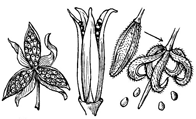
capsule -- a type of simple, dry fruit produced by many species of flowering plants. In most cases the capsule splits apart to release seeds.

fruit -- any seed-bearing structure in flowering plants. It is formed from the ovary after flowering.

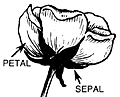
Usually green, sepals typically function as protection for the flower in bud, and often as support for the petals when in bloom.

montane -- inhabiting mountainous country but below timberline.

lobe -- Being divided by clefts.

genus -- A subdivision of a botanical Family in which all members have a significant number of similar characteristics.

lanceolate -- Lance-shaped. Long, wider in the middle.

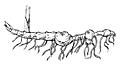
rhizome -- root-like stems that may either grow horizontally at the soil surface or in other orientations underground.