Al Schneider's Rocky Mountains Plant Descriptions

Douglas Fir
Pseudotsuga menziesii
Pine family (Pinaceae)

The Douglas-fir is named for David Douglas, a Scottish botanist who roamed the Northwest in the 1820s, and Archibald Menzies, a fellow Scot who first discovered the tree on Vancouver Island in 1791. Douglas-firs are not true firs, not being members of the Abies. The trees is Pseudotsuga which means "false hemlock." In the 1800s the tree was commonly known as Douglas Spruce. Quite a variety of names for a tree no-one quite knows how to classify. Douglas-fir is an important timber tree, accounting for nearly one-quarter of the total lumber produced in North America. The tree also provides cover and habitat for wildlife.
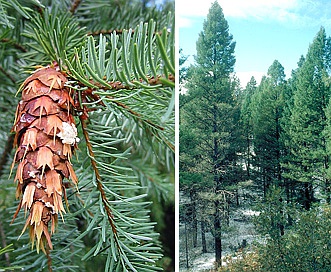

©2005 Walter Siegmund and Dave Powell, USDA
Forest Service
Description

Large conifer, capable of exceeding 200' in height (less in the Colorado Rockies region), with a short, pyramidal, symmetrical at the top of a clear, straight trunk. Distinctive seed cone, 2-4 inches long, is brown with protruding 3-pronged leaf-like that look like the back legs and tail of a mouse diving into a hole. Cones are almost always present, either on the trees or under them. Buds are also distinctive: sharp-pointed, shiny, with red-brown overlapping . Needles are flat, flexible, and without sharp tips (will not roll between fingers).

Field Marks

Massive tree with cones having mouse tail-like projections; needles flat, flexible without sharp tips.

© Al Schneider

canopy -- The foliage of a tree; the crown. Also the upper layer of a forest.

genus -- A subdivision of a botanical Family in which all members have a significant number of similar characteristics.

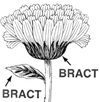
Bracts are modified leaves associated with a flower.

scale -- A very small leaf around a dormant bud. Also other things that might remind one of fish scales on the surface of ferns, stems and the like.