Al Schneider's Rocky Mountains Plant Descriptions

Common Bracken
Pteridium aquilinum
Bracken Ferns family (Dennstaedtiaceae)

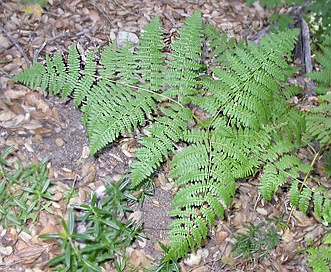
Bracken is the most common fern in the region and is one of the world's most common ferns. It is frequently found in large colonies, often in the shade of Aspens. Most other ferns in the Rocky Mountains are somewhat small and dainty but Bracken reaches 4-7 feet tall and each plant is several feet wide, often overlapping its neighboring Bracken forming a lacy thicket. While Bracken, like other ferns, has bodies, it reproduces almost exclusively by root growth. Bracken's roots are deep, making it very hardy and relatively impervious to drought or excesses of heat or cold. The young , in a fiddlehead shape are tempting to eat but the plant does contain cyanogenic glycosides so there is considerable doubt regarding the safety of eating this plant. Bracken turns brown in fall and dies back in winter. The dried are readily flammable, providing good tinder. "Pteridium" is a diminutive of "Pteris," Greek for "fern," and "aquilinum" is from the Latin for "eagle" and refers to the large wing-like of this very large fern.

©2008 Keir Morse
Description

Large, coarse, fern, up to 4-6' tall, from solitary, stiff stems and . are large, dark green, leathery, and triangular in outline, held almost parallel to ground. divided 2-3 times into round- leaf segments (). commonly , but may be nearly (almost ). hairy beneath and edges rolled under. clusters present along leaf edges. Stem () is smooth, rigid, and grooved on 1 side. The tripartite, very hairy, fiddleheads emerge in early spring. The roots reach deep for moisture, and colonize aggressively.

Field Marks

Tall fern with broad triangular and rigid stems grooved on 1 side.

© Al Schneider

pinnae -- the primary segments of a compound leaf.

frond -- a large, divided leaf. The leaves of most ferns are fronds.

spores are produced by ferns, horsetails, and other primitive plants. Spores are like tiny seeds, but they lack food for the plant embryo. Because spores are easily carried aloft by the wind, they allow ferns and horsetails to reproduce asexually across considerable distances.

Deciduous plants are those that lose all of their leaves for part of the year.

A stipe is a small stalk that supports some other structure. In ferns, the stalk of a frond; generally a small stalk.

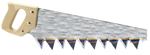
Like the teeth on a saw, leaves and other surfaces can have toothed edges.

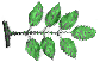
pinnate -- A compound leaf with two rows of leaflets.

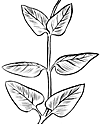
In an opposite leaf arrangement the leaves come in pairs with one leaf on each side of a stem.

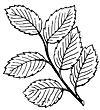
alternate -- leaves alternate along the main stem and are attached singly.

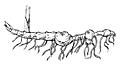
rhizome -- root-like stems that may either grow horizontally at the soil surface or in other orientations underground.