Prairie Pasqueflower
Pulsatilla nuttalliana
Buttercup family (Ranunculaceae)
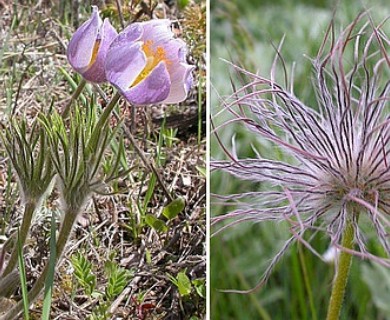
Pasqueflower (Pulsatilla) is among the first wildflowers to bloom. Flowers emerge before the finely cut leaves and often last for many days as the plant develops. Plants often occur in large colonies. Your early spring search for Pulsatilla will probably get you wet and mucky feet, for Pulsatilla is found in the moist of snow melt. Its early blooming time, usually upright flowers, and deeply cut leaves should help distinguish it from Sugarbowls. Its crocus-like flowers give rise to one of its common names, "Prairie Crocus." Late spring and summer visitors will find no flowers, just feathery plumes. All parts of the plant are poisonous and handling it can cause skin irritation.
"Pulsatilla" is from the Latin for "pulsing" or "beating," perhaps alluding to the blood of the sacrificial lambs of Passover. "Pasque" is probably from the Hebrew "paschal," "relating to Passover." "Patens" is Latin for "spreading, open" and may refer to the plant's habit of spreading over large areas and/or to the widely spreading petals or seed head.
©2009 Matt Lavin