Al Schneider's Rocky Mountains Plant Descriptions

Bitterbrush
Purshia tridentata
Rose family (Rosaceae)

Bitterbrush's trident-shaped leaves are somewhat similar to Big Sagebrush (Artemisia tridentata) but bitterbrush leaves are not aromatic and not silvery hairy. The somewhat similar Cliff Rose (Purshia stansburiana) grows alongside Bitterbrush at some elevations but continues to even lower elevations and does not come as high into the foothills. Bitterbrush is important browse for wildlife and is often critical winter browse for mule deer. The shrub has excellent drought tolerance and often has nitrogen-fixing root nodules. The species was first collected for science by Meriwether Lewis in July of 1806 near Lewis and Clark Pass, Montana.
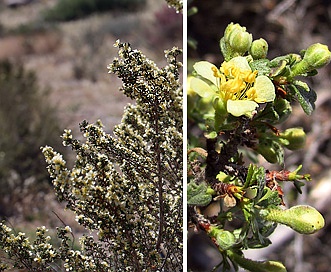

©2015 Steve Matson
Description

Spreading shrub, 3-6' tall and equally wide (usually wider than tall), with grey or brown shredding bark and tightly branched stems covered with hairs. Leaves are , wedge-shaped, deeply three-, with margins that are usually rolled under. Semi- leaves are silvery green hairy upper surface and grey-hairy beneath. Flowers are creamy yellow, 5-petaled, saucer-shaped, and borne singly on short, leafy spurs. are short-hairy .

Field Marks

Densely branched shrub with trident-tipped leaves in dry environments.

© Al Schneider

An evergreen tree retains a large portion of its green leaves all year.

A perennial plant lives and blooms for many years.

achene -- a type of simple dry fruit produced by many species of flowering plants. For example, a rose hip holds a few achenes.

Like the teeth on a saw, leaves and other surfaces can have toothed edges.

Deciduous plants are those that lose all of their leaves for part of the year.

fruit -- any seed-bearing structure in flowering plants. It is formed from the ovary after flowering.

alternate -- leaves alternate along the main stem and are attached singly.