Al Schneider's Rocky Mountains Plant Descriptions

Curlyhead Goldenweed
Pyrrocoma crocea
Aster family (Asteraceae)

Curlyhead Goldenweed (Pyrrocoma crocea looks, at first glance, as if it is a between Mulesears (long, broad, upright ; very large flower head) and Sneezeweed (prominent light-colored leaf mid-vein; long, upright flower stem; large golden yellow flowers with narrow ). It isn't a hybrid of the two but since it shares so many of their characteristics (and habitats), misidentification is easy. The large, rounded, overlapping, cabbage-looking are key in identifying this species. Plants can grow to three feet tall in and may be growing in the same area as Mulesears and Sneezeweed. "Pyrrocoma" is Greek for "tawny mane" and refers to the color. "Crocea," from the Greek for "Crocus," refers to the saffron/orange color of the flower. Charles Parry collected the first specimen of this plant for science in 1862 and Asa Gray named it Haplopappus croceus in 1864 . Edwin Greene renamed it Pyrrocoma crocea in 1894.
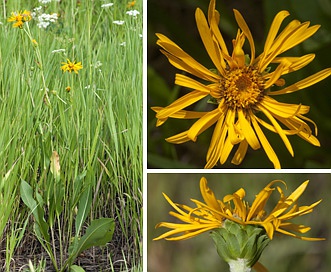

©2015 Richard Spellenberg

Description

, mainly 6 to 24" tall from a simple (woody base of non-woody ) and stout . 3-9" long, and up to 2" wide, to , , , or hairy. reduced upward, , . Heads solitary, hemispheric, about 1/2' high and 1" wide. in several series, to or . 25-70, burnt orange, 2/5 to 1" long. hairs brown. an .

Field Marks

Masses of upright topped by large, showy golden-yellow flowers that are subtended by cabbage-like .

© Al Schneider

meadow -- Large grass and wildflower filled area with few, if any, trees.

achene -- a type of simple dry fruit produced by many species of flowering plants. For example, a rose hip holds a few achenes.

An entire leaf has smooth edges. Not toothed or lobed.

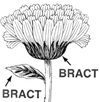
Bracts are modified leaves associated with a flower.

taproot -- The primary decending root of a plant.

glabrous -- smooth, glossy, having no bristles or hair-like structures. Bald.

cauline leaves -- leaves growing on a stem and especially on the upper part.

ray flowers -- The outer petals of a sunflower or daisy are ray flowers.

cross -- To make something interbreed. The act of hybridization.

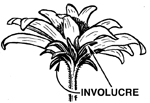
Involucre is the name given to the circle or spiral collection of bracts around a flower-cluster.

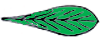
elliptic -- Oval, with no point or a very short point.

basal leaves -- a leaf that grows lowest on the stem of a plant.

A clasping leaf suroundes part of all of the stem.

oblong -- Having an elongated form with somewhat parallel sides. Rectangular.

petiolate -- a leaf that has a stem. A sessile leaf has no stem.

oblanceolate -- top wider than bottom

phyllaries -- Leaflike bracts covering the flowers before opening and remaining under the flower after it opens. Also called "bracts". Only used with the sunflower family (Asteraceae).

A herb is a plant whose stems die back to the ground in the winter.

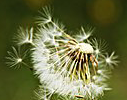
pappus -- Small scales, bristles or hairs at the top of the seed in Asteraceae. For example, dandelion parachutes. Plural: pappi.

fruit -- any seed-bearing structure in flowering plants. It is formed from the ovary after flowering.

sessile -- attached without a stalk. For example, a leaf that clasps the stalk. A petiolate leaf has a stalk.

montane -- inhabiting mountainous country but below timberline.

caudex -- The woody stem base of some herbaceous perennials.

ray flowers -- The outer petals of a sunflower or daisy are ray flowers.

A perennial plant lives and blooms for many years.

ovate -- Oval, egg-shaped, with a tapering point.