Al Schneider's Rocky Mountains Plant Descriptions

Gambel Oak
Quercus gambelii
Beech family (Fagaceae)

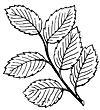
Gambel's Oak is the common (almost the exclusive) oak of the Rocky Mountains. It forms open stands in , often becoming thick and almost impenetrable. In arid areas, Gambel's Oak grows some 6" in diameter and may reach 12' tall. Where water is plentiful, the trees will grow to several feet in diameter and 35' tall. Leaf shape is as variable as tree height, ranging from long to short and deeply to almost no . Gambel's Oak is an ecologically important species providing food and shelter for many wildlife species. The foliage is utilized by mule deer and other browsers while turkey, black bear, and other wildlife seek out the acorns. In the fall, Gambel's Oak often pours down slopes in reds, yellows, and browns. "Quercus" is the classical Latin name for Oaks and "gambelii" honors William Gambel (1821-1849), Western plant collector and Assistant Curator of the National Academy of Sciences.


©2008 Bryant Olsen
Description

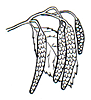
Small, tree to 35' tall, typically 15', with round , often forming thickets from root sprouts. , variably , variably and dissected, leathery, dark green above and paler beneath. Male and female flowers on same plant () with male in yellow pollen-bearing clusters on chains. Female flowers at twig tips are minute versions of the acorns to be. Bark is deeply divided into broad, ridges. Acorns are 3/4-1" long with bowl-shaped caps covering one-third or more of mature .

Field Marks

Short, thicket forming tree; only deeply oak in Rocky Mountain region.

© Al Schneider

A catkin is a tight cylindrical flower cluster where flowers connect directly to a stem. The flowers generally don't have petals and the stem is often drooping.

meadow -- Large grass and wildflower filled area with few, if any, trees.

lobe -- A rounded parts of a leaf (or other organ).

a hard, dry fruit containing only one seed that does not open at maturity.

Deciduous plants are those that lose all of their leaves for part of the year.

Irregular flowers, such as those of the violet or the pea, are often bilaterally symmeteric. These flowers typically have petals of unequal size or shape.

canopy -- The foliage of a tree; the crown. Also the upper layer of a forest.

oblong -- Having an elongated form with somewhat parallel sides. Rectangular.

monoecious -- all flowers have both sexes; or both sexes in different flowers on the same plant.

leaves alternate along the main stem and are attached singly.

lobe -- Being divided by clefts.