Al Schneider's Rocky Mountains Plant Descriptions

Plantainleaf Buttercup
Ranunculus alismifolius
Buttercup family (Ranunculaceae)

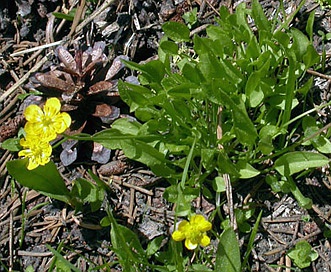
Plantainleaf Buttercup (Ranunculus alismifolius) is an abundant Buttercup, especially in moist . Leaves are long, often broadest in the center and tapered at both ends and the plant is often broader than tall. Like so many other Buttercups, Ranunculus alismifolius flowers are small and only attract oohs and ahhs when they are found in large colonies or when you look at their flowers with a hand lens. Charles Geyer named this species in 1849. "Alismifolius" means "with Plantain-like leaves."

Because of the shape of Ranunculus flowers, bees do not pollinate them very well, but the bees do leave an abundance of pollen on the glossy petals. Dew and rain slide off the slick, shiny surface carrying the pollen to the below to fertilize them. How very interesting the ways of plants are!

The various species of Ranunculus are a bit difficult to tell apart; look first at the leaf shape and the height of the plant. Flower size, color, and shape are very similar and are difficult to use in distinguishing among species. "Ranunculaceae" is an ancient name, probably derived from the Latin "rana," meaning "frog" or "tadpole"; frogs and some Ranunculaceae prefer the same moist habitat. But the name might refer to some long forgotten perceived relationship in size, shape, and smell between flower and frog. Linnaeus named this in 1753.

©2009 Keir Morse

Description

or slightly hairy plants. Stems to 12" long, erect or reclining at base, usually branching above. Leaves 1 to 3" long, some over 1/2" wide, narrowly or oval to , or slightly . shorter than the petals, yellow green, sometimes on the back. Petals 10, rarely 5-9, mostly up to 1/2" long, usually . are 25-60 in a hemispheric or almost head.

Field Marks

Arching leaves topped by bright shiny yellow petals.

© Al Schneider

An entire leaf has smooth edges. Not toothed or lobed.

oblanceolate -- top wider than bottom

A perennial plant lives and blooms for many years.

pubescent -- downy; covered with short, soft, erect hairs.

achene -- a type of simple dry fruit produced by many species of flowering plants. For example, a rose hip holds a few achenes.

subalpine -- Just below the timberline.

denticulate -- Finely toothed. Finer than dentate.

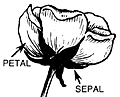
Usually green, sepals typically function as protection for the flower in bud, and often as support for the petals when in bloom.

fruit -- any seed-bearing structure in flowering plants. It is formed from the ovary after flowering.

globose -- Shaped like a ping pong ball, only smaller.

elliptic -- Oval, with no point or a very short point.

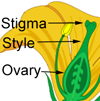
stigma - The tip of a pistil that receives the pollen.

genus -- A subdivision of a botanical Family in which all members have a significant number of similar characteristics.

glabrous -- smooth, glossy, having no bristles or hair-like structures. Bald.

lanceolate -- Lance-shaped. Long, wider in the middle.

meadow -- Large grass and wildflower filled area with few, if any, trees.