Al Schneider's Rocky Mountains Plant Descriptions

Wax Currant
Ribes cereum
Currant family (Grossulariaceae)

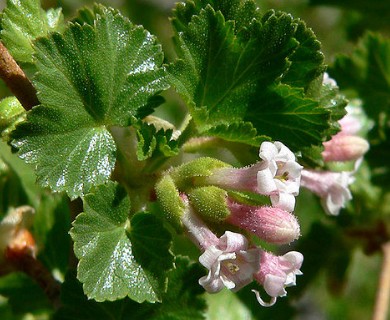
Wax Currant (Ribes cereum) is many-branched and grows to six feet tall on dry sites. Stems are gray and woody without or prickles. Flowers are numerous and white, pink, or light yellow. Leaves are small, rough (from numerous, short, stiff hairs), shallowly , and have a pleasant spicy aroma. Ribes cereum's smooth are soft and juicy, with a mild, but unusual, fruity taste. There are a number of Ribes species in Colorado; key distinguishing factors are the presence or lack of , the size and shape of the leaves, and the color and shape of the flowers.

The highly respected British collector, David Douglas, described and named this plant in 1829 after having collected it along the Columbia River in 1826. He indicated that he found Ribes cereum "throughout the chain of the river Columbia from the Great Falls ... to the source ... in the Rocky Mountains." "Cereum" means "waxy" and refers to the waxy secretion of the leaves.

©2006 Stan Shebs
Description

Shrub to 6' tall and wide, no , much branched, hairy and . Leaf from 1/5 to 1" wide, or kidney -shaped with 3-7 shallow , each or rounded, hairy and or except on margins and along veins beneath. with 2 or 3 flowers. Flower tube to almost 1/2" long, pink, hairy, sometimes also . white or pink, petals minute about 1/25", white. barely . to 1/3", red orange with floral tube still attached, sparingly , rarely . a tasty .

Field Marks

Usually very redolent shrub with hanging clusters of white to red flowers and red .

© Al Schneider

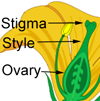
style -- This is a long and thread-like structure that connects the stigma with the ovary. A flower may have a single style, or several of them.

lobe -- Being divided by clefts.

spine -- a stiff, sharp structure formed by the modification of a plant organ that contains vascular tissue. A spine can be formed by a latteral branch, a modified leaf or a thorn.

thorn -- a sharp, still point, usually a modified stem, that cannot be detached without tearing the subtending tissue. A spine.

orbicular -- Circular or nearly circular in outline.

branchlet -- a small branch.

Glands are plant structures that secrete liquids, salts or other substances. Glands often appear as hairs with a drop of liquid at the end.

Like the teeth on a saw, leaves and other surfaces can have toothed edges.

fruit -- any seed-bearing structure in flowering plants. It is formed from the ovary after flowering.

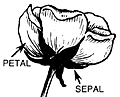
Usually green, sepals typically function as protection for the flower in bud, and often as support for the petals when in bloom.

The botanical term "berry" is different from common usage. Strawberries and raspberries are not berries. But a tomatoe is. A true berry is a fruit with the seeds immersed in the pulp.

hanging or drooping.

lobe -- A rounded parts of a leaf (or other organ).

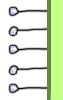
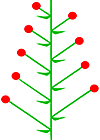
A raceme is an unbranched, indeterminate type of inflorescence bearing flowers having short floral stalks along its axis.

blade -- Just the flat part of a leaf. Not the stem.

glabrous -- smooth, glossy, having no bristles or hair-like structures. Bald.

exserted -- projected beyond. (Exserted stamens project beyond the corolla tube.)