Bog Yellowcress Rorippa palustris Mustard family (Brassicaceae)
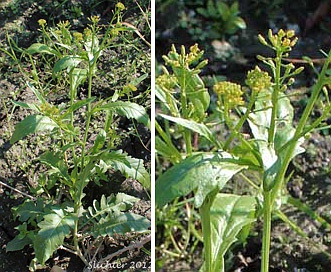
This plant shows great variety in physical structure over its wide range. It is an adaptable plant which grows in many types of damp, wet, and aquatic habitat. Plants form a with deeply- leaves and erect, branched flower stalks. As plants age, leaves become more deeply . Plants are edible raw and taste like peppery lettuce or radishes. Can be dried for storage.
or arising from taproots, often in water, not submerged. Stems 12-40" tall, erect, smooth or hairy. Leaves 1-4" long to an inch wide, , or stem leaves just , with or without and somewhat the stem. Flower clusters () to 4" long. with are curved upward or downward. to 1", petals slightly more, yellow and fading to pink or purple. () up to 1/3" long.
rosette -- usually a dense cluster of leaves at the base of a plant.
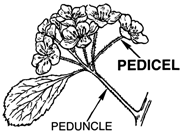
pedicel -- The stem of a single flower.
An annual plant is a plant that completes its life cycle, from germination to the production
of seed, within one year, and then dies.
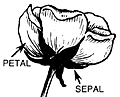
Usually green, sepals typically function as protection for the flower in bud,
and often as support for the petals when in bloom.
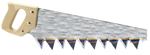
Like the teeth on a saw, leaves and other surfaces can have toothed edges.
fruit -- any seed-bearing structure in flowering plants.
It is formed from the ovary after flowering.
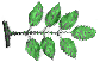
pinnate -- A compound leaf with two rows of leaflets.
biennial -- a plant which lives for two years, producing a basal rosette of leaves
the first year and a full plant, flower, and seed the second year followed by
the death of the entire plant at the end of the second year.
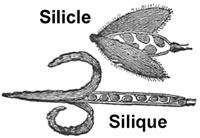
A silique is a long, thin seed capsule with the length more than 3 times the width.
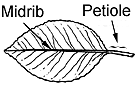
petiole -- the stalk of a leaf.
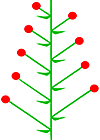
A raceme is an unbranched, indeterminate type of inflorescence bearing flowers
having short floral stalks along its axis.
A clasping leaf suroundes part of all of the stem.