Short-fruit Willow Salix brachycarpa Poplar-Willow family (Salicaceae)
Salix brachycarpa is one of the more common Willows in Colorado and it is abundant at and levels, often forming extensive thickets. The shrub grows to about six feet tall with curving, twisted branches in wide-spreading patches. It is often mixed with other Willows -- all of which are quite difficult to determine to the species. Salix brachycarpa was first collected for science along the Bear River in Idaho by Thomas Nuttall in 1834 and Nuttall named and described the plant in 1842. "Brachycarpa" is Greek for "short ," i.e., "short ."
Erect shrubs to about 3' tall in areas and 6' at lower altitudes. Branches typically short, stout, sometimes twisted, prominent , hairy on new growth, on older, often bark splits. Leaves -, , 1+" long, 1/2"+ wide. very short. Male on very short leafy twigs, about 1/2" long; often red at emergence, yellow at maturity. Female more or even cylindrical, 2/5 to 1" long. about 1/5" long.
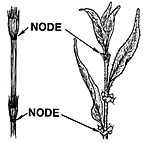
node -- The point at which there is attached growth, as in the place where
each leaf is attached.
An entire leaf has smooth edges. Not toothed or lobed.
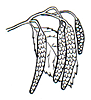
A catkin is a tight cylindrical flower cluster where flowers connect directly to a stem.
The flowers generally don't have petals and the stem is often drooping.
ellipsoid -- Shaped like a watermellon. Smaller.
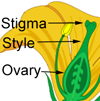
carpel -- the basic female reproductive organ in flowering plants,
consisting of the stigma, style, and ovary.
subalpine -- Just below the timberline.
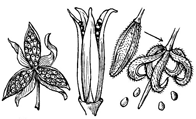
capsule -- a type of simple, dry fruit produced by many species of flowering plants. In
most cases the capsule splits apart to release seeds.
fruit -- any seed-bearing structure in flowering plants.
It is formed from the ovary after flowering.
elliptic -- Oval, with no point or a very short point.