Al Schneider's Rocky Mountains Plant Descriptions

Sandbar Willow
Salix exigua
Poplar-Willow family (Salicaceae)

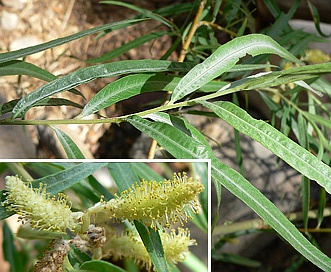
This very common narrow-leaved willow commonly forms dense, single-species stands. Coyote Willow often grows in narrow bands along watercourses, and like many willows, is a pioneer species that establishes itself on newly exposed gravel bars. Exact species identification for most willows is difficult, requiring monitoring the plant for various characteristics (timing of flower and leaf development, size and shape of , size and shape of mature leaves and mature , etc.) through the growing season. Salix exigua is, however, one of the easier species to identify and remember. "Exigua" is Latin for "short," as the plant typically grows to just two or three tall, but it can grow to ten tall. Thomas Nuttall collected the first specimens of this plant for science in 1834 on the banks of the Columbia Rover.

©2008 Stan Shebs
Description

shrub, 6-15' tall, that grows in thickets on various moist soils. , long, and with fine gray hair on upper and lower surfaces. At lower elevations, leaves are shiny green on top and slightly lighter beneath. At higher elevations, leaves are often gray-green with fine gray hairs on both surfaces. Generally, male and female are on different plants.

Field Marks

gray-green to shiny green leaves, near water.

© Al Schneider

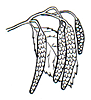
A catkin is a tight cylindrical flower cluster where flowers connect directly to a stem. The flowers generally don't have petals and the stem is often drooping.

linear -- Long and very narrow like a blade of grass.

Deciduous plants are those that lose all of their leaves for part of the year.

m -- A meter is about 10% larger than a yard.

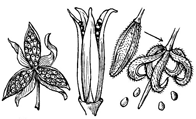
capsule -- a type of simple, dry fruit produced by many species of flowering plants. In most cases the capsule splits apart to release seeds.

A simple leaf blade is one that is not divided into separate leaflets.

leaves alternate along the main stem and are attached singly.