Al Schneider's Rocky Mountains Plant Descriptions

Spearleaf Stonecrop
Sedum lanceolatum
Stonecrop family (Crassulaceae)

The name "Stonecrop" is most likely from one of two archaic meanings: the crop produced by stones or the top of the stones. Many stonecrops are cultivated in gardens. Adapted to dry climates, stonecrops conserve water by closing small pores on their leaves during the day. Rich in vitamins A and C, the plant has been used to treat burns, bites, and wounds. Young leaves and shoots may be eaten raw. "Sedum" is from the Latin "sedo," "to sit," and refers to the habit of some species attaching themselves to stones(thus the "top of stones" definition). "Lanceolatum" describes the leaf shape.
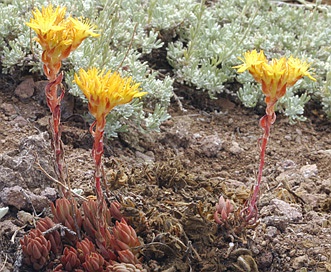

©2005 Steve Matson
Description

Succulent , 6-12" tall, with prominent, star-shaped yellow flowers in compact, flat-topped cluster. Flowers have 5 , pointed petals, sometimes red-tinged. are long and obvious. Fleshy leaves are blunt-tipped and on stems. Stems are green, yellow, or red and hairless. vary in color from green to red brown.

Field Marks

Yellow star-shaped flowers on short succulent plant in rocky areas.

© Al Schneider

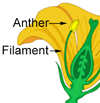
stamen -- the pollen-producing reproductive organ of a flower; The stamen consists of an anther supported by a filament.

A perennial plant lives and blooms for many years.

A herb is a plant whose stems die back to the ground in the winter.

basal leaves -- a leaf that grows lowest on the stem of a plant.

alternate -- leaves alternate along the main stem and are attached singly.

lanceolate -- Lance-shaped. Long, wider in the middle.

linear -- Long and very narrow like a blade of grass.