Showy Alpine Ragwort
Senecio amplectens
Aster family (Asteraceae)
For Senecio amplectens variety amplectens
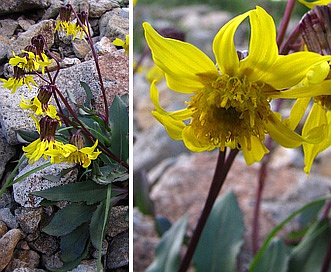
This is a common, very cheerful sunflower that grows scattered or in small patches in high mountain mid-summer. It grows very straight and upright, but its flowers demurely nod. Flower are a bright lemon-yellow and tips are pointed. Some botanical keys indicate that are withered at flowering time, but can be present at flowering time. are wider, longer, and more numerous than stem leaves; all leaves may be relatively smooth-margined or . "Amplect" is "to embrace," referring to the way in which the base of the leaf clasps the stem. Asa Gray named this plant Senecio amplectens in 1862 from a specimen collected by Charles Parry in Colorado. Several authoritative botanical sources now combine this species with Senecio holmii and treat the two as varieties.
©2011 Bryant Olsen
Description
plants with mostly single stems from 8-24" tall, leafy cluster, to slightly hairy when young. Leaves mostly , reduced in size and few in number upward on the stem, 3-6" long, to , on upper leaf tips to , (but often with very long, narrowed leaf base), or slightly hairy. Flowerheads 1 to few, 3/5 to 4/5" wide, nodding. broadly , , often dark purple, or with some hairs on inner side. 2/5 to 4/5" long, lemon yellow, pointed at tip. an .Field Marks
Pointed tip, lemon yellow nodding at the top of nearly leafless stems.For Senecio amplectens variety holmii
Those who never climb to fields miss so much. But even those who do, often miss the flowers because the rocks are so pervasive and arresting. Careful observation reveals numerous species of plants tucked into lichen-covered and talus fields. The lichen and wind and water erosion provide the soil for these plants to thrive. One such plant is the lovely Senecio amplectens variety holmii. This plant grows from two to eight inches (rarely twelve) with a mass of vertical, red-tinged, thick leaves and drooping, bright lemon yellow flowers. This is now considered a close cousin to S. amplectens variety amplectens but although a look at the photos will show similarities it will also show major differences including the habitat, height, hairiness, leaf shape, and leaf color. Herman Holm was a naturalist, explorer, and Assistant Botanist of the United States Department of Agriculture. He collected and wrote about Colorado flora.