Al Schneider's Rocky Mountains Plant Descriptions

Tall Blacktip Ragwort
Senecio atratus
Aster family (Asteraceae)

We like to call this Senecio, "Roadside Senecio," for it is very common in extensive colonies along high mountain roads. Senecio atratus is such a tall, robust, attractive plant that it is easy to identify even from a distance: it has tall, nearly vertical leaves, it grows in large colonies, and its leaves appear sage-green -- because they are covered in a tangle of white hairs. Senecio atratus was first collected for science by Edward Greene in Colorado and he named it in 1896. "Atratus" (Latin for "clothed in black") refers to the black-tipped below the yellow flower petals.
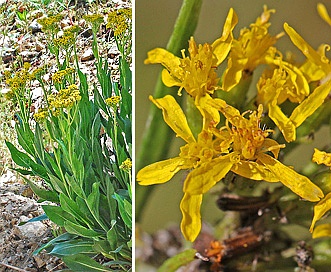

©2013 Jerry Oldenettel

Description

plants with long rootstocks, forming colonies. Stems to 30" tall, hairy, leafy but leaves reduced upwards. 4-8" long, to , mostly to , very hairy on both sides. Upper stem leaves , . Flowerheads about 2/5" high, numerous. of the to about 1/3" long, conspicuously black-tipped. 3-5 to 1/3" long, often curling, yellow. a .

Field Marks

Robust plant with numerous long, sage green leaves topped by even more numerous clusters of tiny yellow flowers.

© Al Schneider

An entire leaf has smooth edges. Not toothed or lobed.

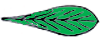
oblanceolate -- top wider than bottom

A perennial plant lives and blooms for many years.

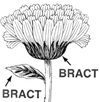
phyllaries -- Leaflike bracts covering the flowers before opening and remaining under the flower after it opens. Also called "bracts". Only used with the sunflower family (Asteraceae).

achene -- a type of simple dry fruit produced by many species of flowering plants. For example, a rose hip holds a few achenes.

ray flowers -- The outer petals of a sunflower or daisy are ray flowers.

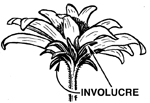
Involucre is the name given to the circle or spiral collection of bracts around a flower-cluster.

Bracts are modified leaves associated with a flower.

sessile -- attached without a stalk. For example, a leaf that clasps the stalk. A petiolate leaf has a stalk.

fruit -- any seed-bearing structure in flowering plants. It is formed from the ovary after flowering.

lanceolate -- Lance-shaped. Long, wider in the middle.

basal leaves -- a leaf that grows lowest on the stem of a plant.

glabrous -- smooth, glossy, having no bristles or hair-like structures. Bald.

dentate -- with sharp, outward-pointing teeth

oblong -- Having an elongated form with somewhat parallel sides. Rectangular.