Al Schneider's Rocky Mountains Plant Descriptions

Thickleaf Ragwort
Senecio crassulus
Aster family (Asteraceae)

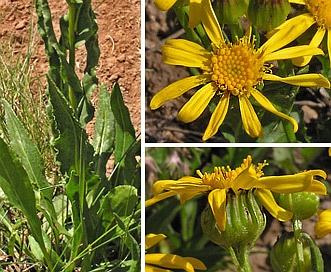
Thickleaf Senecio (Senecio crassulus) is a common plant of high , especially near and above tree-line. It grows six-to-twenty inches tall with thick, dark green, coarsely-, somewhat hairy, often vertical leaves that clasp the stem and often have winged . Senecio crassulus flowerheads are large and showy, ray petals are few but long, narrow, and yellow to yellow-gold, the central disk flowers are golden. Senecio crassulus often grows near the similar looking Hymenoxys hoopesii which is, however, taller with larger flowers and leaves. Senecio integerrimus, which also is common from low to high mountain , has smaller flowers, few small leaves on the main stem, and is usually very much hairier than Senecio crassulus.

Charles Parry collected this plant in Colorado and it was named by Asa Gray in 1883. bulge and thus the specific epithet: "crass" is Latin for "thick." "Senecio" is from the Latin, "senes," "old man," and refers to the hairs, the white, tiny, hair-like growth at the of the seeds in Asteraceae.

©2004 Al Schneider

Description

, with (woody base of non-woody ). Stems erect, from 6-18" tall. Herbage . Lower leaves broadly , the main leaves from 1+ to 6" long and 1/2 to over 1" wide, to or , coarsely , , or . gradually reduced upward, becoming and . Flowerheads solitary or 2-12 in clusters. to 1/2" high and almost twice as wide with 8-21 , thickened on back and at base (), green to brown, black tips with tufted hairs. 8-13, yellow, 1/5 to 1/2" long. a .

Field Marks

Upright cluster of pointed with prominent mid-vein, leaves reduced in size and upward on stem.

© Al Schneider

meadow -- Large grass and wildflower filled area with few, if any, trees.

achene -- a type of simple dry fruit produced by many species of flowering plants. For example, a rose hip holds a few achenes.

An entire leaf has smooth edges. Not toothed or lobed.

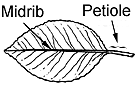
petiole -- the stalk of a leaf.

glabrous -- smooth, glossy, having no bristles or hair-like structures. Bald.

dentate -- with sharp, outward-pointing teeth

cauline leaves -- leaves growing on a stem and especially on the upper part.

The apex is the tip or the furthest point from the attachment.

ray flowers -- The outer petals of a sunflower or daisy are ray flowers.

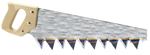
serrate -- toothed with asymmetrical teeth pointing forward; like the cutting edge of a saw.

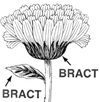
Bracts are modified leaves associated with a flower.

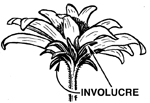
Involucre is the name given to the circle or spiral collection of bracts around a flower-cluster.

Like the teeth on a saw, leaves and other surfaces can have toothed edges.

lanceolate -- Lance-shaped. Long, wider in the middle.

elliptic -- Oval, with no point or a very short point.

basal leaves -- a leaf that grows lowest on the stem of a plant.

A clasping leaf suroundes part of all of the stem.

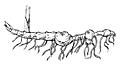
rhizome -- root-like stems that may either grow horizontally at the soil surface or in other orientations underground.

petiolate -- a leaf that has a stem. A sessile leaf has no stem.

oblanceolate -- top wider than bottom

A herb is a plant whose stems die back to the ground in the winter.

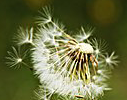
pappus -- Small scales, bristles or hairs at the top of the seed in Asteraceae. For example, dandelion parachutes. Plural: pappi.

fruit -- any seed-bearing structure in flowering plants. It is formed from the ovary after flowering.

sessile -- attached without a stalk. For example, a leaf that clasps the stalk. A petiolate leaf has a stalk.

caudex -- The woody stem base of some herbaceous perennials.

A perennial plant lives and blooms for many years.

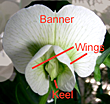
In a pea flower the two bottom petals are fused together forming a boat-like structure called the keel. The glumes of grasses may have a sharp projecting ridge like the keel of a boat.