Al Schneider's Rocky Mountains Plant Descriptions

Drummond's Campion
Silene drummondii
Pink family (Caryophyllaceae)

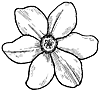
Silene drummondii is most easily spotted by looking for its tuft of bright . The long, lanky stems, typically growing to eighteen inches, are difficult to see against a or forest background, and flowers are no easier to spot: petals (either pink or white) are but several millimeters long; the longer is a bit more noticeable with its 10 veins and hairiness (which makes the quite sticky).

William Jackson Hooker named the species Silene drummondii in 1830, probably from a specimen collected by Thomas Drummond, naturalist and explorer of North America. Linnaeus named the Silene in 1753 for Silenus, the drunken foster-father of the Greek God Bacchus. Silenus was often covered with foam from his drunkenness, and this led to the association with the sticky secretions of many Silenes.
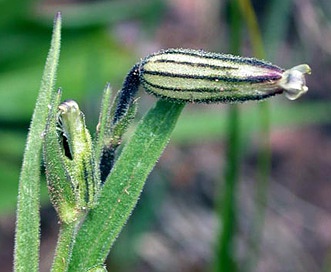

© Mary Ellen (Mel) Harte, Bugwood.org
Description

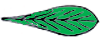
from a . Stems to 2' tall, hairy below and above and above. with to 4" long and 2/3" wide, , , or , , or hairy, ; stem leaves 2-5 pairs becoming and reduced in size upward. Flowers 1 to several in few-flowered clusters. bell to -shaped about 1/2 inch long. white or tinged pink, little or barely from , petals notched. a .

Field Marks

Tall, slender plant with long, narrow, sticky, 10 veined . White to pink petals barely visible.

© Al Schneider

ciliate -- fringed with hairs

petiolate -- a leaf that has a stem. A sessile leaf has no stem.

oblanceolate -- top wider than bottom

exserted -- projected beyond. (Exserted stamens project beyond the corolla tube.)

A perennial plant lives and blooms for many years.

turbinate -- shaped like a spinning top or beetroot.

A herb is a plant whose stems die back to the ground in the winter.

corolla -- The name for all the petals of a flower taken together.

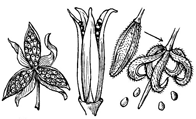
capsule -- a type of simple, dry fruit produced by many species of flowering plants. In most cases the capsule splits apart to release seeds.

taproot -- The primary decending root of a plant.

Glands are plant structures that secrete liquids, salts or other substances. Glands often appear as hairs with a drop of liquid at the end.

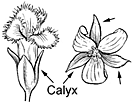
calyx -- the sepals of a flower, typically forming a whorl that encloses the petals and forms a protective layer around a flower in bud.

fruit -- any seed-bearing structure in flowering plants. It is formed from the ovary after flowering.

sessile -- attached without a stalk. For example, a leaf that clasps the stalk. A petiolate leaf has a stalk.

elliptic -- Oval, with no point or a very short point.

basal leaves -- a leaf that grows lowest on the stem of a plant.

genus -- A subdivision of a botanical Family in which all members have a significant number of similar characteristics.

blade -- Just the flat part of a leaf. Not the stem.

glabrous -- smooth, glossy, having no bristles or hair-like structures. Bald.

lanceolate -- Lance-shaped. Long, wider in the middle.

meadow -- Large grass and wildflower filled area with few, if any, trees.