Al Schneider's Rocky Mountains Plant Descriptions

Menzies' Campion
Silene menziesii
Pink family (Caryophyllaceae)

The "Catchfly" common name of Silene menziesii comes from its (sticky) hairs. These plants commonly grow in large colonies because they sprout from elongated underground roots. This plant is easily confused with Largeleaf Sandwort (Moehringia macrophylla).

Catchfly was first named by William Hooker in 1830. Archibald Menzies, physician and naturalist aboard several major 18th century sea and land explorations, was the first scientist to explore the Pacific Northwest. Pseudotsuga menziesii, what we now commonly call Douglas Fir, was first collected for science by Menzies, not Douglas. The Silene was named by Linnaeus in 1753, and the name is, according to the "Flora of North America", "probably derived from 'Silenus', the intoxicated foster father of the Greek god Bacchus, [god of wine] who was described as covered with foam; perhaps this alludes to the secretion covering many species [in the Silene ]."

©2003 Steve Matson

Description

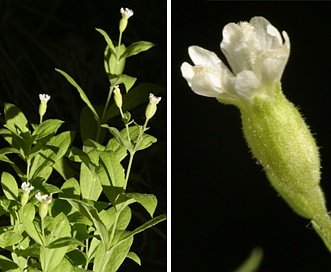
, some plants only male, some only female, some having both. 2-12" tall, with generally elliptical leaves up to 3" long, having short hairs and sticky . The flower stems are erect, the bell-shaped, up to 1/3" long, and also sticky . The white flowers are about 1/2" wide, with 5 petals deeply notched into two .

Field Marks

Dainty plant in colonies with white upright flowers, notched petals, and .

© Al Schneider

viscid -- Sticky.

A perennial plant lives and blooms for many years.

lobe -- A rounded parts of a leaf (or other organ).

A herb is a plant whose stems die back to the ground in the winter.

Glands are plant structures that secrete liquids, salts or other substances. Glands often appear as hairs with a drop of liquid at the end.

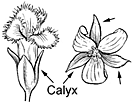
calyx -- the sepals of a flower, typically forming a whorl that encloses the petals and forms a protective layer around a flower in bud.

genus -- A subdivision of a botanical Family in which all members have a significant number of similar characteristics.