Al Schneider's Rocky Mountains Plant Descriptions

Colorado Starwort
Stellaria irrigua
Pink family (Caryophyllaceae)

This tiny plant is, according to Colorado flora authority William Weber, "locally common on at high altitudes," but overall it is listed as rare in the very few Colorado and New Mexico counties in which it is found. The only other occurrences of this plant are in the Altai Mountains of Siberia, where it was first discovered and where it is also rare. The "Flora of North America" indicates, "Stellaria irrigua has a remarkable and perhaps uniquely distribution." Stellaria irrigua is unusual also in its floral structure. The white petals are cut deeply and they and the are laid back against the colorful . Leaves and are green and maroon. The plant is so minute that it is difficult -- but rewarding -- to find on slopes. Bunge named this plant in 1835 from Siberian specimens.


© Mary Ellen (Mel) Harte, Bugwood.org

Description

plants with ; forming mats or low cushions. Stems to spreading, branched, 4-sided, less than 1" to at most 4" tall, , inter- usually shorter than the leaves. Leaves , with prominent , or to , fleshy, , . with flowers solitary in upper leaf axils, often concealed among leaves. erect but becoming curved upwards. Flowers about 1/4", 5, purple tinged. Petals 5, about 1/12", shorter than , deeply cut in two. 5, inserted in prominent . 3. a green becoming straw colored .

Field Marks

Minute plant with leathery leaves and minute white flowers, petals shorter than .

© Al Schneider

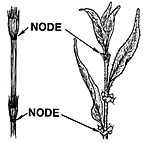
node -- The point at which there is attached growth, as in the place where each leaf is attached.

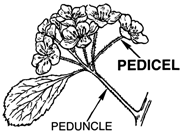
pedicel -- The stem of a single flower.

glabrous -- smooth, glossy, having no bristles or hair-like structures. Bald.

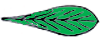
lanceolate -- Lance-shaped. Long, wider in the middle.

nectar -- A sweet fluid produced by the nectary in flowers and collected by bees and other insects.

disjunct -- Occuring widely in separated areas, as in disjunct plant populations.

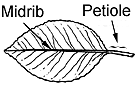
midrib -- The central and most prominent vein of a leaf or leaf-like thing.

disc flowers are those in the center of a sunflower or daisy. Not a ray flower.

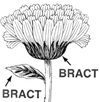
Bracts are modified leaves associated with a flower.

scree -- field of small, loose, slab rock. Common high on mountains.

elliptic -- Oval, with no point or a very short point.

alpine -- above the tree line. Thin soil, rocks, short growing season, frost, winter snow.

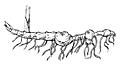
rhizome -- root-like stems that may either grow horizontally at the soil surface or in other orientations underground.

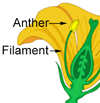
stamen -- the pollen-producing reproductive organ of a flower; The stamen consists of an anther supported by a filament.

An entire leaf has smooth edges. Not toothed or lobed.

oblanceolate -- top wider than bottom

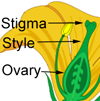
style -- This is a long and thread-like structure that connects the stigma with the ovary. A flower may have a single style, or several of them.

ascending -- growing obliquely upward and usually curved.

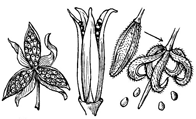
capsule -- a type of simple, dry fruit produced by many species of flowering plants. In most cases the capsule splits apart to release seeds.

fruit -- any seed-bearing structure in flowering plants. It is formed from the ovary after flowering.

sessile -- attached without a stalk. For example, a leaf that clasps the stalk. A petiolate leaf has a stalk.

An inflorescence is a group or cluster of flowers arranged on a stem.

A perennial plant lives and blooms for many years.

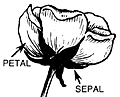
Usually green, sepals typically function as protection for the flower in bud, and often as support for the petals when in bloom.

elongate -- long and thin, slender.

blade -- Just the flat part of a leaf. Not the stem.