Al Schneider's Rocky Mountains Plant Descriptions

Roundleaf Snowberry
Symphoricarpos rotundifolius
Honeysuckle family (Caprifoliaceae)

This is a very common shrub, especially under Aspens where it frequently accompanies you for miles along the trail. Its flowers are fragrant, numerous, and noticeable and its also are numerous and quite visible and long-lasting for it seems few if any critters enjoy eating them.

There are, according to some botanist, two species of Snowberry in the Rockies: S. oreophilus and S. rotundifolius. If they are distinct species, they seem to be so on the basis of a few small characteristics: the former is said to be slightly taller, have vs. hairy young twigs, vs. , or sparsely hairy interior vs. very hairy lower interior.

Utah flora expert Stanley Welsh accepts S. oreophilus as the name of the single species; Colorado flora expert William Weber accepts S. rotundifolius; and national flora expert John Kartesz indicates that their are two distinct species. The original plant that gave rise to this confusion was first collected for science by Charles Parry in Colorado and was named Symphoricarpos oreophilus by Asa Gray in 1873; it was renamed Symphoricarpos rotundifolius variety oreophilus by Marcus Jones in 1895. "Symphoricarpos" is from the Greek "symphorein," "borne together," and "karpos," "," and refers to the closely packed . "Oreophilus" means "mountain loving."


©2008 Barry Breckling

Description

Shrubs mainly to 4 1/2' tall, young stems hairy to . Leaves to about 2" long and 1" wide (noticeably larger on young shoots), to , or few-. Flowers solitary or paired in leaf axils and sometimes also in , few-flowered . tubular- to bell shaped, mostly 2/5 to 1/2" long with much shorter than the tube, hairy or . are longer than the . is a white .

Field Marks

Rounded, open shrubs with numerous pink to white flowers and white .

© Al Schneider

terminal -- Located at the end (the tip or the apex).

An entire leaf has smooth edges. Not toothed or lobed.

funnelform -- Shaped like a funnel, as in the morning-glory flower.

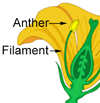
The anther is a pad at the end of the stamen that holds the pollen.

lobe -- A rounded parts of a leaf (or other organ).

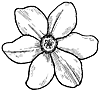
corolla -- The name for all the petals of a flower taken together.

ovate -- Oval, egg-shaped, with a tapering point.

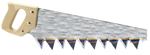
Like the teeth on a saw, leaves and other surfaces can have toothed edges.

ciliate -- fringed with hairs

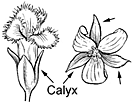
calyx -- the sepals of a flower, typically forming a whorl that encloses the petals and forms a protective layer around a flower in bud.

fruit -- any seed-bearing structure in flowering plants. It is formed from the ovary after flowering.

The botanical term "berry" is different from common usage. Strawberries and raspberries are not berries. But a tomatoe is. A true berry is a fruit with the seeds immersed in the pulp.

elliptic -- Oval, with no point or a very short point.

A raceme is an unbranched, indeterminate type of inflorescence bearing flowers having short floral stalks along its axis.

glabrous -- smooth, glossy, having no bristles or hair-like structures. Bald.

filament -- The stalk of a stamen. Other very narrow, thread-like structures.