Al Schneider's Rocky Mountains Plant Descriptions

Common Dandelion
Taraxacum officinale
Aster family (Asteraceae)

Dandelions are among the longest blooming, widest spread, most adaptable plants in the Rockies (and, of course, many other locations). They seed easily from the widely dispersed seeds (carried on the fluff of hairs) and they find a home in wet, dry, high, low, forested, and open locations. The leaves and flowers have been eaten for centuries. Countless hours have been spent by millions of home owners sitting on their front lawns gazing in admiration at this beautiful creation. Mountain in early spring, as soon as the snows are off, are commonly carpeted in acres of Dandelions.

Linnaeus named this plant Leontodon taraxacum in 1753 and it received its present name in 1779 from George Weber. "Taraxacum" may be a thousand+ years old name traceable through Arabic to the Persian "talkh chakok," meaning 'bitter ,' or the name may be from the Greek "tarassein," "to stir up," referring to the plant's reputed medicinal qualities. The common name is a condensation of the French "dent de lion" (also the Latin "Leontodon"), "lion's tooth," referring to the on the leaves.

©2004 Anthony Valois and the National Park Service
Description

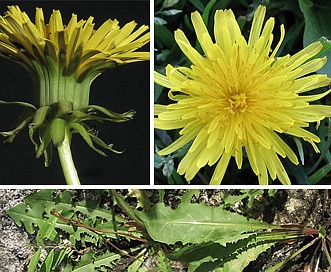
plants from 2-20" tall from a deep root. Leaves from 2-15" long and up to 4 inches wide, to . Stems hairy to almost smooth and often hairy right below the flowerhead. Outer of the narrow, , and strongly curved back. All , yellow. an .

Field Marks

Bright yellow single flower atop a straight stem above a of deeply cut leaves.

© Al Schneider

A perennial plant lives and blooms for many years.

pinnatifid -- A leaf shape that is pinnately lobed but not cut all the way to the axis.

achene -- a type of simple dry fruit produced by many species of flowering plants. For example, a rose hip holds a few achenes.

A herb is a plant whose stems die back to the ground in the winter.

ray flowers -- The outer petals of a sunflower or daisy are ray flowers.

rosette -- usually a dense cluster of leaves at the base of a plant.

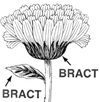
Bracts are modified leaves associated with a flower.

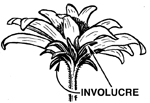
Involucre is the name given to the circle or spiral collection of bracts around a flower-cluster.

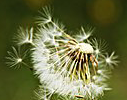
pappus -- Small scales, bristles or hairs at the top of the seed in Asteraceae. For example, dandelion parachutes. Plural: pappi.

basal -- at the base, situated or attached at the base.

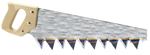
Like the teeth on a saw, leaves and other surfaces can have toothed edges.

fruit -- any seed-bearing structure in flowering plants. It is formed from the ovary after flowering.

pinnately lobed -- Having lobes pinnately arranged on the central axis.

lanceolate -- Lance-shaped. Long, wider in the middle.

meadow -- Large grass and wildflower filled area with few, if any, trees.