Al Schneider's Rocky Mountains Plant Descriptions

Pygmy Goldenweed
Tonestus pygmaeus
Aster family (Asteraceae)

This common tiny Sunflower, found only above tree-line, forms small mounds from three to twelve inches in diameter topped with bright flowers. Leaves are long, narrow, upright, prominently veined, and (fringed with fine hairs). The plant is found in and on , often in the meager soils collected around rocks. can be quite straight or curled over. Leaves are curved inward or flat. Green below the flower head are broad, blunt, and fringed with fine hairs (""). A quick glance could lead you to identifying this as a Golden Aster, especially as Golden-Aster (Heterotheca pumila), but the latter is a much taller and broader plant with larger flowers. A comparison of the leaves also shows clear differences. One of the great joys of botany is constantly being reminded to look and then look again.

"Tonestus" is a meaningless anagram of "Stenotus," another in the Sunflower Family. John Torrey and Asa Gray named this plant Haplopappus pygmaeus and Aven Nelson, who named this in 1904, renamed it Tonestus pygmaeus.
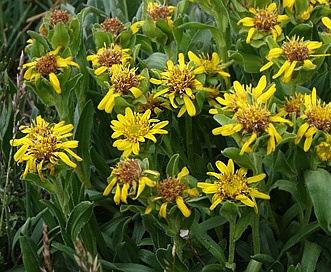

©2013 Al Schneider

Description

plant with stems from less than 1 to 2+" tall, several to many stems from a forming a cushion, hairy, leafy. Leaves 1-2" long and 1/15 to 1/5" wide, , , hairy at least on the margins. Flowerheads solitary with numerous large, leafy surrounding the flowerhead. 2/5" long and 1/3"+ wide. 15-30, about 1/4" long. a slightly hairy .

Field Marks

Tiny plant with relatively large yellow flowers surrounded by large, leaf-like .

© Al Schneider

taproot -- The primary decending root of a plant.

An entire leaf has smooth edges. Not toothed or lobed.

oblanceolate -- top wider than bottom

meadow -- Large grass and wildflower filled area with few, if any, trees.

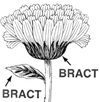
phyllaries -- Leaflike bracts covering the flowers before opening and remaining under the flower after it opens. Also called "bracts". Only used with the sunflower family (Asteraceae).

achene -- a type of simple dry fruit produced by many species of flowering plants. For example, a rose hip holds a few achenes.

A herb is a plant whose stems die back to the ground in the winter.

ray flowers -- The outer petals of a sunflower or daisy are ray flowers.

Bracts are modified leaves associated with a flower.

tundra -- Land above tree line characterized by a short growing season, intense sun and wind, thin soils, very high snow fall and high rain fall. Contains low growing sedges, grasses, dwarf shrubs and herbs.

compressed -- flattened lengthwise, either laterally (from side to side) or dorsally (from front to back).

ciliate -- fringed with hairs

fruit -- any seed-bearing structure in flowering plants. It is formed from the ovary after flowering.

A perennial plant lives and blooms for many years.

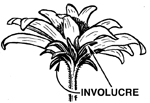
Involucre is the name given to the circle or spiral collection of bracts around a flower-cluster.

genus -- A subdivision of a botanical Family in which all members have a significant number of similar characteristics.

alpine -- above the tree line. Thin soil, rocks, short growing season, frost, winter snow.