Al Schneider's Rocky Mountains Plant Descriptions

Yellow Salsify
Tragopogon dubius
Aster family (Asteraceae)

Introduced from Europe as a root crop, Salsify has spread across much of North America. Flowers open at sunup and close tightly around noon on cloudy days earning them the name "Jack-go- to-bed-at-noon." Tragopogon lamottei is a very similar (also non-native) species found in similar habitats. It has maroon tinged the same length as the flower petals, in contrast to the very long, green of T. dubious. Also the flower petals of T. lamottei are wide and blunt-tipped.

"Tragos" is Greek for "goat" and "pogon" for "beard," thus giving another common name for both of these species, "Goat's Beard." The was named by Linnaeus in 1753 and this species was first collected near the Adriatic Sea.
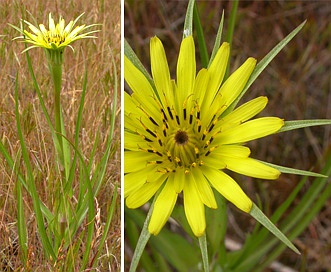

©2009 Matt Lavin

Description

Introduced , 1-3' tall. Yellow flower with only, these surrounded by 10-14 green, narrow and pointed (conspicuously longer than petals) on a hairless, hollow stem with milky sap. Leaves are , long, , tapering from base toward tip. Seedhead is conspicuous globe of white feathery . is an .

Field Marks

Yellow with green extending beyond petals; seed head like that of Dandelion but twice as large.

© Al Schneider

ray flowers -- The outer petals of a sunflower or daisy are ray flowers.

linear -- Long and very narrow like a blade of grass.

bristle -- A straight, stiff hair.

achene -- a type of simple dry fruit produced by many species of flowering plants. For example, a rose hip holds a few achenes.

A herb is a plant whose stems die back to the ground in the winter.

ray flowers -- The outer petals of a sunflower or daisy are ray flowers.

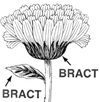
Bracts are modified leaves associated with a flower.

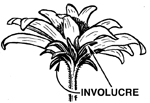
Involucre is the name given to the circle or spiral collection of bracts around a flower-cluster.

fruit -- any seed-bearing structure in flowering plants. It is formed from the ovary after flowering.

biennial -- a plant which lives for two years, producing a basal rosette of leaves the first year and a full plant, flower, and seed the second year followed by the death of the entire plant at the end of the second year.

genus -- A subdivision of a botanical Family in which all members have a significant number of similar characteristics.

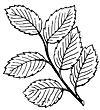
alternate -- leaves alternate along the main stem and are attached singly.