Al Schneider's Rocky Mountains Plant Descriptions

Slender Stinging Nettle
Urtica gracilis
Nettle family (Urticaceae)

Nettle stems are armed with tiny, hollow pointed hairs containing irritating compounds including histamine. The hairs and compounds cause itching/burning when they come into contact with skin. The discomfort can last from minutes to days, depending on an individual's sensitivity. A common relief is to flood the affected area with water or apply a paste of baking soda and water. Applying tape to skin can remove the barbs. Young shoots can be boiled and eaten like spinach and the older stem fibers were commonly used to make rope and cloth. Stinging Nettle is often found at the base of rocky slopes where the water it enjoys is pushed to the surface. Plants may grow to four feet tall if they get enough water. Along streams in the East, a related species grows to six feet tall in dense patches. Linnaeus named the Urtica in 1753. "Urtica" is Latin for "to burn," and "dioica" is Latin for "two homes," referring to the nature of the plant.


©2021 Tom Norton

Description

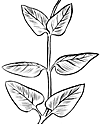
Erect , 18"-54" tall, with 4-sided stems with stinging hairs. Leaves are , narrowly , and coarsely . prominent and leaf stems nearly one-half length of leaf. Small inconspicuous green flowers are arranged in hanging clusters () arising from upper leaf clusters.

Field Marks

Coarsely leaves; 4-sided stems with stinging hairs.

© Al Schneider

A perennial plant lives and blooms for many years.

A herb is a plant whose stems die back to the ground in the winter.

Like the teeth on a saw, leaves and other surfaces can have toothed edges.

scree -- field of small, loose, slab rock. Common high on mountains.

In an opposite leaf arrangement the leaves come in pairs with one leaf on each side of a stem.

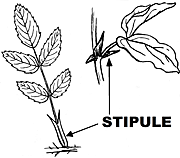
stipule -- A leaf-like structure that occurs where the leaf joins the stem; stipules often occur in pairs.

A panicle is a much-branched inflorescence. The bottom flowers in a panicle open first.

genus -- A subdivision of a botanical Family in which all members have a significant number of similar characteristics.

dioecious -- When male and female reproductive structures are on separate plants.

lanceolate -- Lance-shaped. Long, wider in the middle.