Al Schneider's Rocky Mountains Plant Descriptions

Common Bladderwort
Utricularia macrorhiza
Bladderwort family (Lentibulariaceae)

The web of submerged growth appears to be roots but is the finely divided leaves. They can be coated with pond growth, but the bladders ( leaf segments), clearly show and if you clean off the pond growth, you can see the vein-like leaf system. Utricularia macrorhiza is carnivorous; its bladders have a minute opening that traps insects, crustaceans, and Parameciums. Often just the tiny yellow flowers of Utricularia macrorhiza show above the water surface. Careful examination will show you the flower stem system supporting fully opened flowers and a number of buds. Leaves and bladders are submerged. Linnaeus named and described this and species in 1753. "Utricularia" is Latin for "a little bag" and refers to the bladder pods. "Macrorhiza" means large roots, which we now know is a misnomer since what appear to be roots are really leaves. There are several other species of this in our area.


©2021 Benoit Renaud
Description

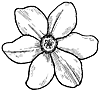
without roots, free floating in water. Stems usually floating. 2/5 to 1 1/2" long, divided into numerous angled and very narrow segments. Bladders only 1/25 to 1/5" wide, borne on the leaves. 3-12" long. 2-12 flowered. about 1/2" long with a hornlike spur shorter than the lower lip but conspicuous and somewhat curved.

Field Marks

Bright yellow flowers floating above mass of fibrous stems and leaves.

© Al Schneider

genus -- A subdivision of a botanical Family in which all members have a significant number of similar characteristics.

A perennial plant lives and blooms for many years.

A herb is a plant whose stems die back to the ground in the winter.

corolla -- The name for all the petals of a flower taken together.

scape -- a long, leafless flower stalk coming directly from a root. The tulip has a scape.

inflated -- Swollen. Looks unusually large.

A raceme is an unbranched, indeterminate type of inflorescence bearing flowers having short floral stalks along its axis.

leaves alternate along the main stem and are attached singly.