Al Schneider's Rocky Mountains Plant Descriptions

Edible Valerian
Valeriana edulis
Valerian family (Valerianaceae)

Look for this plant rising above surrounding grasses and wildflowers of and . As the common and scientific names suggest, Edible Valerian is considered edible when cooked, but the taste is described as very strong with an odor that many find unpleasant. The plant has a number of medicinal uses, and legend has it that the Pied Piper used a valerian to lure the rats out of Hamlin.

David Douglas was the first to collect this plant for science in the present day Spokane area in the 1820s or early 1830s; it was named by Thomas Nuttall in 1841. "Valerian" refers either to a Roman Emperor or (more probably) to the Latin word for strength, "valere," referring to the belief in Valerian's potency as a tonic and relaxant.


©2010 Barry Breckling
Description

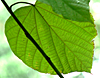
Tall , up to 4' tall, from a stout . Flowers begin in tight clusters that gradually mature into an elongated, open . Very small white-yellow tubular flowers have 5 spreading . are thick, to with white-lined margin. Conspicuous veins are nearly parallel with . Stems have 2-6 pairs of small leaves divided into 3-7 segments. are tipped with feathery . Male and female flowers on separate plants ().

Field Marks

Open of white flowers. Leaves with conspicuous veins paralleling .

© Al Schneider

nerves -- Another name for a vein.

An entire leaf has smooth edges. Not toothed or lobed.

A perennial plant lives and blooms for many years.

pinnatifid -- A leaf shape that is pinnately lobed but not cut all the way to the axis.

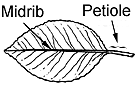
midrib -- The central and most prominent vein of a leaf or leaf-like thing.

lobe -- A rounded parts of a leaf (or other organ).

A herb is a plant whose stems die back to the ground in the winter.

subalpine -- Just below the timberline.

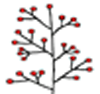
A panicle is a much-branched inflorescence. The bottom flowers in a panicle open first.

ovate -- Oval, egg-shaped, with a tapering point.

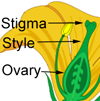
style -- This is a long and thread-like structure that connects the stigma with the ovary. A flower may have a single style, or several of them.

obovate -- Teardrop-shaped, stem attaches to tapering point.

dioecious -- When male and female reproductive structures are on separate plants.

taproot -- The primary decending root of a plant.

achene -- a type of simple dry fruit produced by many species of flowering plants. For example, a rose hip holds a few achenes.

linear -- Long and very narrow like a blade of grass.

fruit -- any seed-bearing structure in flowering plants. It is formed from the ovary after flowering.

montane -- inhabiting mountainous country but below timberline.

basal leaves -- a leaf that grows lowest on the stem of a plant.

meadow -- Large grass and wildflower filled area with few, if any, trees.