Al Schneider's Rocky Mountains Plant Descriptions

Great Mullein
Verbascum thapsus
Figwort family (Scrophulariaceae)

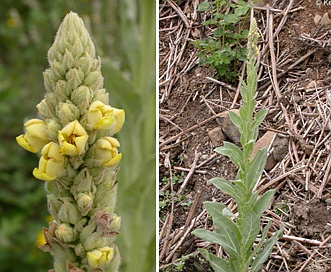
Large fuzzy leaves can provide a soft alternative for those in need of toilet paper, and they can't be confused with Poison Ivy. This plant has a large number of medicinal uses including a tea made from the roots to prevent incontinence. In the first year the plant produces only a of thick long leaves. Mullein flowers are quite small, bright yellow, with only a few blooming at a time, dying, and then being overshadowed by a few new flowers blooming as the flower elongates."Verbascum" (probably a corruption of "Barbascum") is an ancient Latin name used by Pliny for some member of this , and "thapsus" probably refers to the city of Thapsos in ancient Greece. Linnaeus named this large (about 250 species through Europe and Asia) and this species in 1753.

©2008 Keir Morse
Description

Erect, very hairy , 15-60" tall, topped with a of yellow saucer-shaped flowers. Stem leaves are , , pale green, and large. First year growth consists of of leaves to 24" long. Stems persist through winter.

Field Marks

Tall plant with yellow flower and huge of hairy felt-like leaves.

© Al Schneider

rosette -- usually a dense cluster of leaves at the base of a plant.

A herb is a plant whose stems die back to the ground in the winter.

basal -- at the base, situated or attached at the base.

stalk -- The supporting structure of an organ. Examples of stalks are stem, peduncle, petiole, ...

biennial -- a plant which lives for two years, producing a basal rosette of leaves the first year and a full plant, flower, and seed the second year followed by the death of the entire plant at the end of the second year.

A spike is an unbranched, indeterminate inflorescence in which the flowers are without stalks.

genus -- A subdivision of a botanical Family in which all members have a significant number of similar characteristics.

alternate -- leaves alternate along the main stem and are attached singly.

lanceolate -- Lance-shaped. Long, wider in the middle.